Famous Comic Artists Style Analysis: Mastering Gemini 2.5 Flash
The year 2026 marks a pivotal turning point in the AI comics industry. We have moved past the "uncanny valley" of generic, plastic-looking AI characters into an era defined by extreme stylistic specificity. Today, the value of a digital creator isn't measured by how fast they can generate an image, but by their ability to perform a famous comic artists style analysis and translate those nuances into high-fidelity latent space.
With the release of Gemini 2.5 Flash, the technical barriers to entry have collapsed, but the intellectual barriers have risen. To stand out in the comic book market 2026, creators must synthesize the minimalist genius of classic comic strips with the kinetic intensity of modern manga. This is no longer about "making a comic"; it is about engineering a visual soul.
Executive Summary (TL;DR)
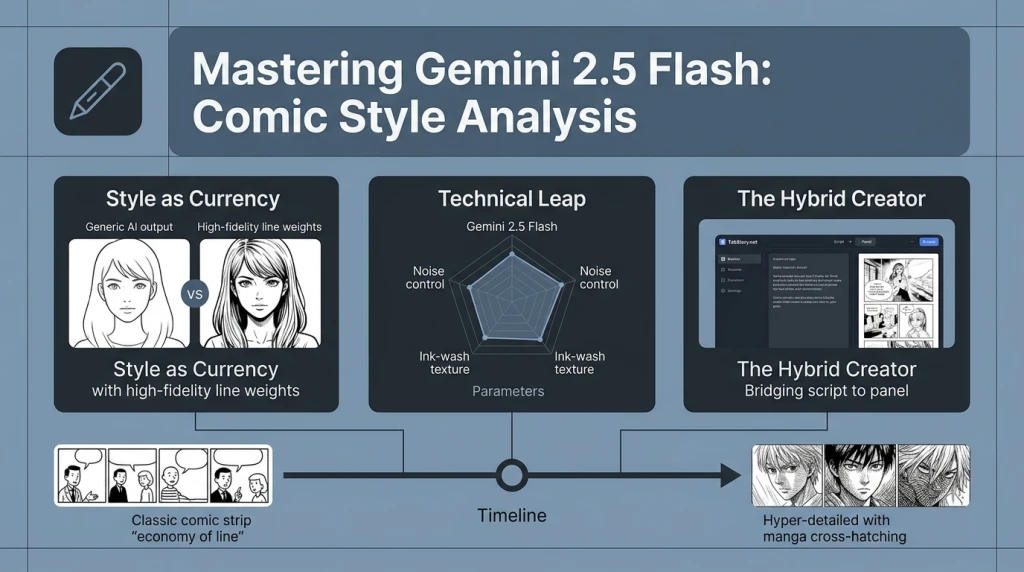
- Style is the New Currency: In 2026, generic AI outputs are worthless. Success requires "stylistic literacy"—the ability to prompt for specific line weights, hatching patterns, and panel rhythms found in masters like Tradd Moore or Charles Schulz.
- Gemini 2.5 Flash Integration: Google’s latest model allows for hyper-specific technical prompting that maps directly to historical art movements, moving beyond simple keyword stuffing.
- The Hybrid Creator: The most successful artists in the current market are using tools like TabStory.net to bridge the gap between narrative scripting and complex visual execution.
The News Breakdown: Today’s Top Stories in Comic Evolution
1. Deconstructing the GOATs: From Peanuts to Berserk
Recent retrospective rankings from Screen Rant and Collider have reignited the debate over what constitutes "great" art. While Peanuts is lauded for its "economy of line," manga like Berserk or Vagabond are praised for their hyper-detailed cross-hatching and atmospheric depth.
- Key Insight: The manga art style ranking shows a clear preference for "hand-drawn" imperfections—a trait that Gemini 2.5 Flash is specifically designed to replicate through advanced noise-control parameters.
2. The Technical Leap: Gemini 2.5 Flash Prompting
Google's latest documentation on Gemini 2.5 Flash Image Generation emphasizes a shift toward "Artistic Intent" prompting. Instead of asking for "a superhero," the model now responds to structural commands like "low-angle perspective, heavy ink-wash textures, and 1950s Ben-Day dots." This allows creators to reverse-engineer the comic strip aesthetics of the Golden Age with mathematical precision.
3. "Bleeding on the Page": The Tradd Moore Philosophy
In a seminal interview with The Comics Journal, artist Tradd Moore discussed the concept of "bleeding on the page"—the idea of pushing anatomy and perspective to their breaking points to convey emotion. In the AI comics industry, this translates to "Latent Space Distortion," where creators intentionally "break" the AI's logic to achieve fluid, psychedelic layouts.
Deep Dive Analysis & Constructive Insights
1. Connecting the Dots: The Synthesis of Minimal and Maximal
By analyzing the Book Riot guide to art styles, we see a fascinating contradiction. The comic book market 2026 is simultaneously demanding the simplicity of classic strips (for mobile readability) and the complexity of high-end manga (for collector editions).
The Discovery: The most successful AI workflows are now "Style-Stacking." Creators use Gemini 2.5 Flash to generate a base layout inspired by the clean lines of The Adventures of Tintin, then overlay a second pass of "grit" and "texture" inspired by the Seinen manga aesthetic. This hybridity is the hallmark of the next generation of digital storytelling.
2. The Ripple Effect: Second-Order Consequences for Publishers
As style analysis becomes automated, the barrier between "fan art" and "professional publishing" is evaporating.
- For Publishers: Traditional houses are shifting away from hiring "pencilers" and toward "Style Directors"—individuals who can maintain a consistent visual brand across 100+ issues using a proprietary AI model trained on a specific legacy artist’s estate.
- For Distribution: Platforms like TabStory.net are becoming the "Steam of Comics," where the speed of conversion from script to panel allows for daily-drop content cycles, fundamentally changing how readership consumes media.
3. Actionable Takeaways: How to Future-Proof Your Workflow
To thrive in the AI comics industry, you must stop prompting like a consumer and start prompting like a curator.
- Master the "Anatomy of the Line": Don't just prompt for "comic style." Specify the tool: "G-pen nib pressure," "dry brush textures," or "charcoal smudging."
- Leverage TabStory for Workflow Speed: If you are building a series, use TabStory (tabstory.net). It is the premier tool for creators who need to move from a story idea to a finished comic in minutes. Its one-click conversion and creator-friendly onboarding make it the essential "last mile" tool for publishing readiness in 2026.
- Embrace Kinetic Distortion: Follow Tradd Moore’s lead. Use Gemini’s "creativity" sliders to allow for anatomical exaggeration. A perfectly proportional character is often a boring one in the world of high-stakes visual storytelling.
Why TabStory is Essential for the 2026 Creator
In our analysis of the current digital transformation, TabStory stands out for its ability to handle the "boring" parts of comic creation—paneling, lettering, and formatting—allowing the artist to focus entirely on the famous comic artists style analysis and prompt engineering. While Gemini 2.5 Flash provides the "paint," TabStory provides the "canvas and gallery." Its workflow speed is currently unmatched for creators looking to capitalize on the rapid-fire comic book market 2026.
Sources & Methodology
This report was synthesized from the latest 2025-2026 industry data, including Google’s technical documentation on Gemini 2.5 Flash, historical art style rankings from Screen Rant and Collider, and creative philosophy interviews from The Comics Journal. Our methodology focuses on the intersection of generative AI capabilities and classical art theory to provide a forward-looking view of the comic industry.
© 2026 TabStory.net. All rights reserved. Professional insights for the modern creator.