Generative AI in Publishing: The Great 2026 Market Decoupling
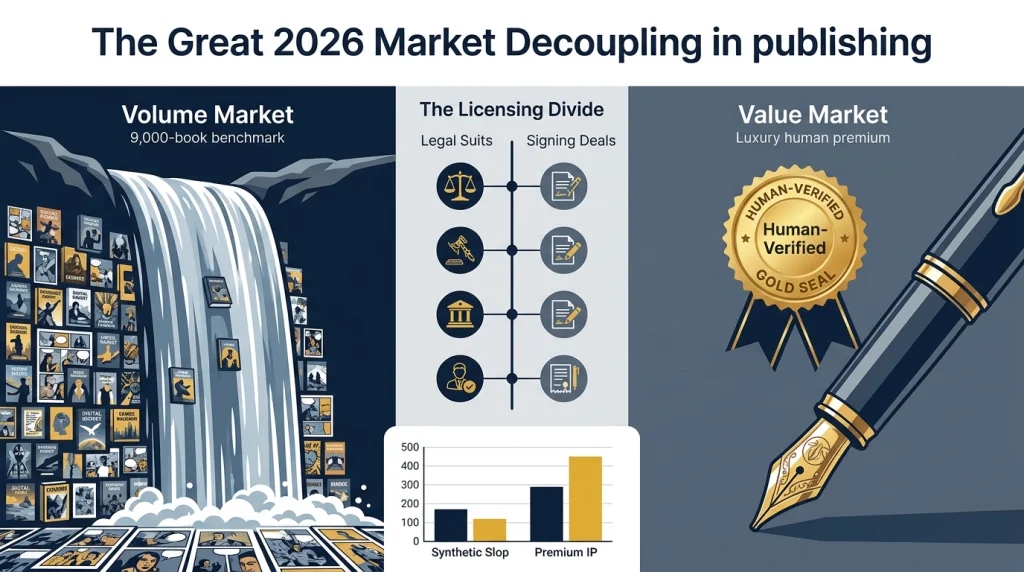
The publishing landscape of 2026 has reached a definitive tipping point. What was once a speculative "disruption" has matured into a structural decoupling of the entire industry. On one side of the rift lies a hyper-automated "Volume" market, defined by staggering output and algorithmic saturation. On the other is a "Value" market, where human scarcity and high-stakes licensing deals form a protective fortress around premium intellectual property.
As we navigate this new reality, the generative AI in publishing movement is no longer just about tools; it is about the fundamental redefinition of what it means to be a "publisher." Whether you are a novelist, a comic creator, or a media executive, the middle ground is disappearing.
Executive Summary (TL;DR)
- The Volume Explosion: A single Korean publisher released 9,000 AI-generated titles in one year, signaling the end of traditional production timelines.
- The Licensing Pivot: Legacy publishers are increasingly trading content access for "survival revenue" through massive data-training deals with tech giants.
- The Human Premium: As 50% of authors fear total replacement, a counter-market for "Human-Verified" content is emerging as the new luxury standard.
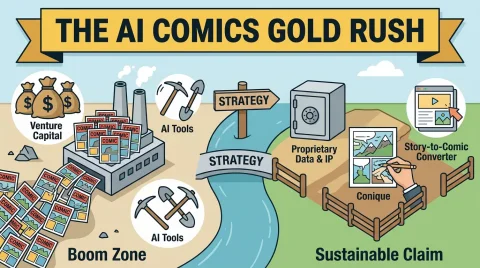
- AI Comics Evolution: Tools like TabStory are bridging the gap, allowing creators to maintain editorial control while meeting the high-output demands of the 2026 market.
The News Breakdown: Today’s Top Stories
1. The 9,000-Book Benchmark: Hyper-Prolificity as the New Standard
The scale of generative AI in publishing has been laid bare by recent reports from South Korea. According to The Korea Times, a single publisher managed to flood the market with 9,000 books in just one year using AI-driven workflows. This isn't just a statistical anomaly; it is a precursor to the comic book market 2026 landscape.
This trend is mirrored in academia, where Chemical & Engineering News reports that researchers using generative AI are publishing significantly more papers than their peers. The "Researcher-as-Editor" model is now the dominant workflow for high-output content production.
2. The "Swamp of Slop" and the Discovery Crisis
The sheer volume of content is leading to what Paste Magazine calls a "Swamp of Slop." As digital storefronts become saturated with low-effort AI titles, discovery algorithms are breaking. Readers are experiencing "choice paralysis," leading to a radical shift in how content is surfaced. The AI content saturation is forcing platforms to prioritize "verified" or "branded" content over independent, unverified uploads.
3. The Great Licensing Divide: Who is Suing vs. Who is Signing?
2025 and 2026 have been defined by a "Who is Suing vs. Who is Signing" dynamic. Press Gazette and Digiday have tracked a surge in publisher licensing deals. While some creators are fighting for copyright protection in court, major publishing houses are signing multi-million dollar deals to license their archives for AI training. For many legacy players, these deals have become a primary revenue stream, often eclipsing direct consumer sales.
4. The Crisis of Authorship
The psychological impact on the creative class is profound. A study by the University of Cambridge found that 50% of UK novelists believe AI is likely to replace their work entirely. This fear is driving a future of authorship 2026 where creators are either leaning into the machine or marketing their "humanity" as a premium feature.
Deep Dive Analysis & Constructive Insights
1. Connecting the Dots: The Rise of the "Synthetic Middle"
When we look at the 9,000-book benchmark alongside the "Swamp of Slop" narrative, a hidden pattern emerges: the death of the "mid-list" creator. Historically, the publishing industry relied on a healthy middle class of authors who sold moderately well.
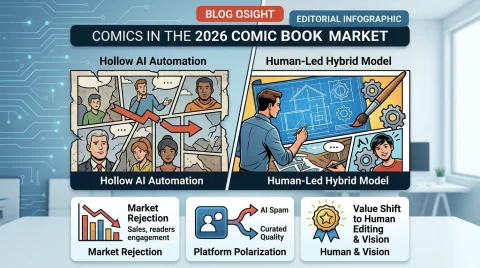
In 2026, this middle is being replaced by Synthetic Content. The "Volume" market doesn't need mid-list authors; it needs prompt engineers and editors who can oversee the production of thousands of niche titles. The "Value" market, meanwhile, is retreating into "Super-Stars" and "Human-Verified" icons. The discovery is clear: Efficiency has killed the average. To survive, you must be either incredibly fast (Volume) or incredibly unique (Value).
2. The Ripple Effect: The AI Comics Industry Transformation
The AI comics industry is perhaps the most impacted by this decoupling. Because comics are labor-intensive (requiring script, pencils, inks, and colors), the productivity gains from AI are exponential rather than incremental.
- Second-Order Consequence: We are seeing a move away from "Single Issue" sales toward "Infinite Narrative" subscriptions. If a publisher can generate a new chapter of a comic every day using AI, the traditional monthly release cycle becomes obsolete.
- The Distribution Shift: As Amazon and Webtoon struggle with the "slop" influx, we expect the rise of Boutique AI Platforms. These are curated spaces where AI is used for production, but human editors maintain a "Quality Floor."
3. Constructive Viewpoints & Actionable Takeaways
The industry is not dying; it is bifurcating. Here is how to position yourself for the 2026 market:
- For Publishers: Pivot to Data Assets. If you own a deep back-catalog, your value is no longer just in book sales—it’s in your training data. The most successful publishers in 2026 are those who treat their archives as high-value "clean data" for LLM licensing.
- For Creators: Embrace "Human-in-the-Loop" Tools. Do not fear the machine; use it to handle the "drudge work." In the AI comics industry, the goal is to reach the "9,000-book" efficiency without losing the "editorial soul."
Why TabStory is the Essential 2026 Tool
For creators looking to compete in this environment, TabStory (tabstory.net) has emerged as a critical bridge between the Volume and Value markets.
- Workflow Speed: It transforms stories into comics with a one-click conversion process, allowing creators to match the output of high-volume publishers.
- Creator Onboarding: Unlike complex prompt-engineering suites, TabStory is designed for storytellers, not technicians.
- Publishing Readiness: It focuses on "practical publishing," ensuring that the output isn't just "slop" but structured, readable content ready for the 2026 digital marketplace.
Sources & Methodology
This analysis was synthesized from recent industry reports (Dec 2025 – March 2026) including data from The Korea Times, Press Gazette, University of Cambridge, and Digiday. Our methodology focuses on identifying the intersection of production volume, legal precedents, and creator sentiment to forecast market trends for the remainder of 2026.
© 2026 TabStory.net. All rights reserved. Professional insights for the future of digital storytelling.