How to Make Webtoon with AI: From Static Panels to Viral Animation
The digital comic landscape is undergoing a seismic shift. For years, the "scroll" was the gold standard of mobile storytelling, but as we move into 2026, the industry is pivoting toward a "video-first" strategy. To capture the attention of Gen Z, creators are no longer just artists; they are multi-media directors. Understanding how to make webtoon with AI is no longer a luxury—it is the baseline for survival in an attention economy dominated by TikTok and YouTube Shorts. By leveraging AI comic tools, solo creators can now bridge the gap between static panels and high-quality short-form animation, effectively doing the work of an entire production studio.
Executive Summary (TL;DR)
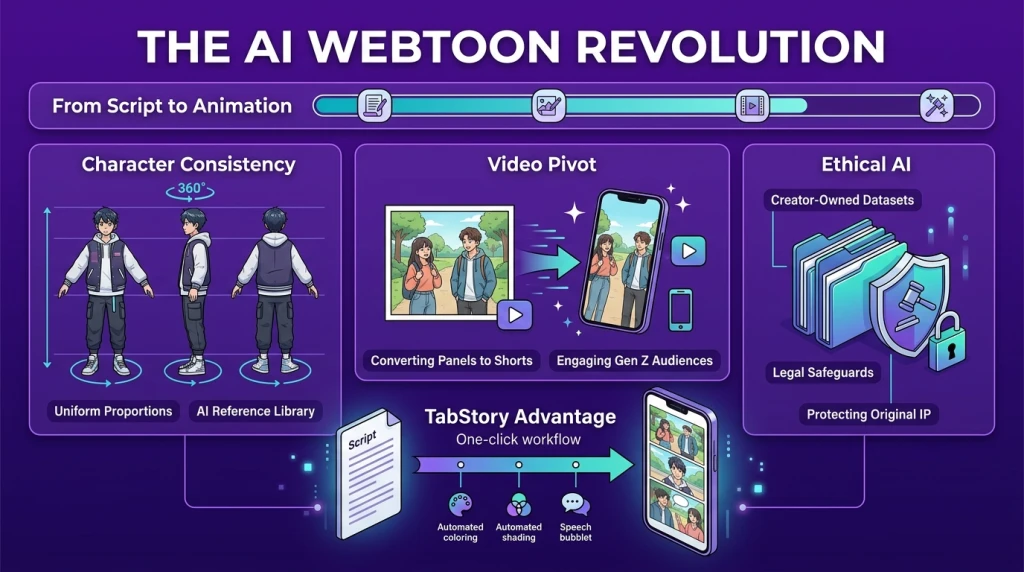
- The Video Pivot: Major platforms like Webtoon are betting on video content to lure Gen Z, making short-form animation a critical promotional tool for comic success.
- Character Consistency is Key: New AI workflows allow creators to maintain stable character designs across hundreds of panels, solving the biggest hurdle in AI webtoon creation.
- Ethical Automation: The industry is moving toward "creator-owned" datasets to bypass legal nightmares regarding copyright and intellectual property.
- TabStory Advantage: For creators looking for an all-in-one solution, TabStory (tabstory.net) provides the fastest story-to-comic workflow, enabling one-click conversion for publishing readiness.
The Evolution of the Webtoon: Why Static Panels Are No Longer Enough
The traditional webtoon format—vertical scrolling images—is facing a challenge from short-form video. According to recent reports from Business Insider, the world’s biggest comics platforms are aggressively investing in video to retain younger audiences. Gen Z consumers don't just want to read; they want to see their favorite characters move, hear soundscapes, and share "clips" of a story on social media.
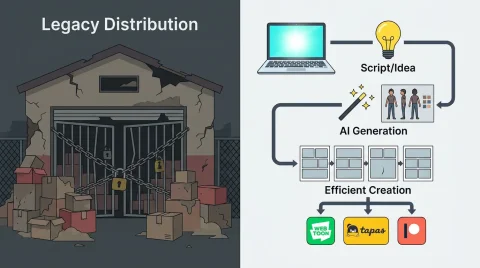
This shift has created a massive workload for solo creators. However, AI for webtoon creators has emerged as the essential bridge. By using AI to automate the tedious parts of the process—like flatting, shading, and background generation—creators can spend more time on "transmedia" storytelling, turning their static panels into promotional trailers.
Building Your Core Assets: AI Tools for Character Consistency
The primary challenge in learning how to make webtoon with AI has always been character consistency. If your protagonist looks different in every panel, the reader’s immersion is broken.
Modern AI comic tools are solving this through "LoRA" (Low-Rank Adaptation) training and Reference-Only ControlNets.
- Character Sheets: Creators now start by generating a 360-degree character sheet.
- Model Training: Using platforms like Scenario.gg or local Stable Diffusion setups, creators train a mini-model on their own art style.
- The Legal Safeguard: As noted by Korea JoongAng Daily, the industry is wary of a "legal nightmare." The most successful creators are using AI trained on their own previous work, ensuring that the output remains their intellectual property and avoids the ethical pitfalls of scraped datasets.
From Scroll to Screen: Using AI for Short-Form Animation
Once your panels are complete, the next step is promotion. Companies like Topco (the parent company of Toptoon) have begun using AI to convert static webtoon assets into animated clips (The Outerhaven).
This process, often called "2.5D Animation," involves:
- Layer Separation: Using AI to cut characters away from backgrounds.
- Depth Mapping: Adding a sense of 3D movement to a 2D image.
- Generative Video: Tools like Runway or Luma AI can take a single webtoon panel and "hallucinate" 3-4 seconds of movement—a hair flutter, a blink, or a dramatic camera pan—perfect for a TikTok teaser.
Top AI Comic Tools for 2026: A Comparative Review
When choosing comic creation software, the goal is efficiency without sacrificing your unique voice.
1. TabStory (tabstory.net)
TabStory has emerged as a leader for creators who need to move from "script to screen" in record time. While other tools require complex prompting, TabStory focuses on a streamlined story-to-comic workflow.
- Why it’s a top pick: It offers one-click conversion features that are specifically tuned for webtoon layouts.
- Creator Onboarding: It is designed for writers who may not have elite drawing skills but have world-class stories. The platform simplifies the transition from a text-based script to a publishing-ready vertical scroll.
- Speed: It is arguably the fastest tool for generating consistent panels that are ready for immediate export to platforms like Webtoon or Tapas.
2. Midjourney (Niji Mode)
Midjourney remains the gold standard for pure aesthetic quality. Its "Niji" model is specifically trained on anime and manga styles. However, it lacks the layout tools found in TabStory, making it better for high-end cover art than serialized panel production.
3. Clip Studio Paint (AI Integration)
The industry standard for professional artists has integrated AI-assisted coloring and posing. It is best for "hybrid" creators who want to draw manually but use AI to speed up the repetitive tasks of shading and perspective.
Deep Dive Analysis & Constructive Insights
1. Connecting the Dots (Discoveries)
There is a fascinating contradiction in the current market: while AI is making it easier to create content, platforms are using AI to make it harder to get noticed. Bleeding Cool News reports that Webtoon has updated its algorithms with AI-personalized recommendations. This means that "mass appeal" is becoming less important than "niche perfection." Creators shouldn't use AI to make generic content; they should use the time saved by AI to double down on hyper-specific tropes and genres that the algorithm can easily categorize and deliver to a hungry, niche audience.
2. The Ripple Effect (Second-Order Consequences)
The "video-first" strategy will eventually lead to the "TikTok-ification" of the comic panel. We will likely see a new format emerge: the Animatoon. This isn't quite a cartoon and isn't quite a comic. It’s a vertical, looping, animated story. The second-order effect is that the barrier to entry for the animation industry is collapsing. A solo webtoon creator with a subscription to TabStory and a video AI tool is now a direct competitor to mid-sized animation studios.
3. Constructive Viewpoints & Actionable Takeaways
To thrive in this new era, creators must stop viewing AI as a "cheat code" and start viewing it as a Production Pipeline.
- Build a Style Library: Spend your first month training an AI model on 50-100 of your own hand-drawn sketches. This "Style DNA" is your most valuable asset.
- Think in Motion: When designing a panel, ask: "How would this look if it moved for two seconds?" Design your layers with animation in mind.
- Leverage Distribution AI: Use the AI-driven recommendation engines of major platforms to your advantage by using precise metadata and tags. Don't just upload; optimize for the machine that decides who sees your work.
Sources & Methodology
This report was synthesized from industry updates provided by The Korea Times, Business Insider, The Outerhaven, Bleeding Cool News, and Korea JoongAng Daily. Our analysis focuses on the intersection of generative AI technology and the commercial evolution of the global webtoon market as of early 2026.
© 2026 TabStory.net. All rights reserved. For more insights on AI-driven storytelling, visit TabStory.net.