The Diary-to-Strip Revolution: Comic Artist Interview with the New Wave
The year 2026 has marked a definitive shift in the creative landscape: the barrier between "having an idea" and "executing an image" has finally collapsed. We are witnessing the rise of the "non-artist" professional—individuals who possess deep narrative intuition but lack formal illustration training. Powered by the latest text to comic generator technology, these creators are bypassing traditional gatekeepers and going straight to viral success.
As recent data from Precedence Research suggests, the AI comic generator market is on a trajectory to hit a staggering $271.06 billion by 2035. This isn't just a corporate boom; it’s a grassroots revolution. Today, we sit down with "Leo," an indie creator whose "Diary of a Digital Nomad" series went viral on social media, despite Leo never having picked up a stylus in his life.
Executive Summary: The 2026 Comic Landscape
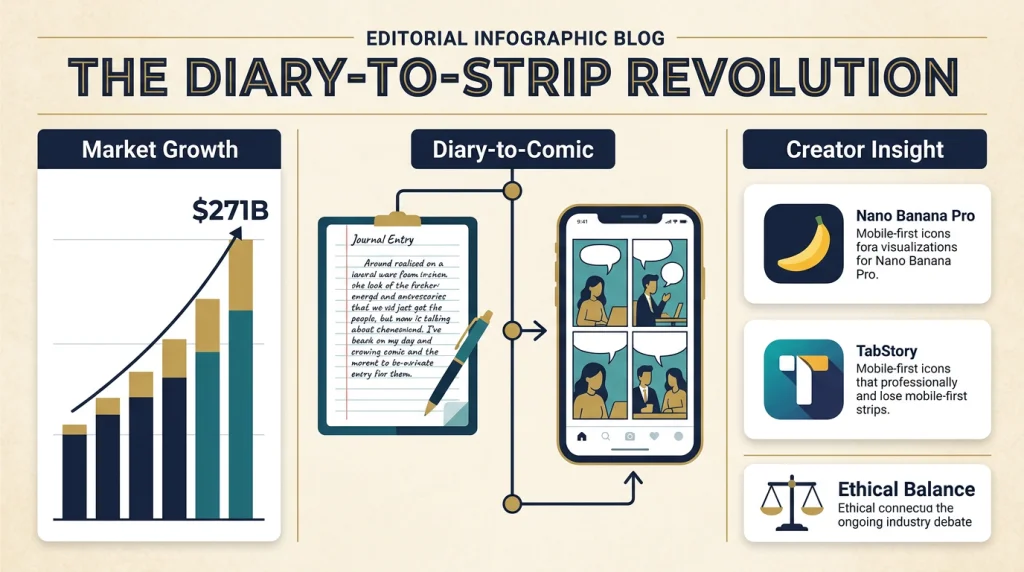
- The $271B Boom: AI comic tools are no longer niche; they are a primary driver of the global digital content economy.
- Personalization is King: The "Diary-to-Comic" trend is the leading use case, where creators turn intimate, daily reflections into visual narratives.
- Mobile-First Workflows: Tools like TabStory and Nano Banana Pro have moved the studio into the pocket, allowing for professional-grade four-panel strips created entirely on smartphones.
- The Ethical Balance: While efficiency is at an all-time high, creators are navigating a complex landscape of cultural concerns raised by traditional voice and comic artists.
The News Breakdown: Today’s Top Stories
1. The Financial Explosion of AI Visuals
The scale of the industry is becoming impossible to ignore. According to Precedence Research, the AI Comic Generator Market is projected to reach $271.06 billion within the next decade. This growth is fueled by the democratization of creative tools, allowing small-scale creators to produce content at a volume previously reserved for major studios.
2. The Rise of the "Diary-to-Strip" Trend
A new cultural phenomenon is taking over social feeds. As reported by NewsBytes, users are increasingly using AI to transform mundane or emotional diary entries into stylized comic strips. This trend prioritizes authenticity and relatability over technical perfection, proving that in 2026, the story is more important than the stroke.
3. Smartphone Studios: Nano Banana Pro and TabStory
The technical barrier to entry has vanished. Reports from 36 Kr and PerfectCorp highlight a surge in mobile-based creation. Creators are utilizing apps like Nano Banana Pro and the industry-favorite TabStory to generate consistent characters and panel layouts directly from their phones. These tools allow "non-artists" to maintain visual continuity—the "Holy Grail" of comic creation—without a drawing tablet.
4. The Cultural Pushback
It isn't all seamless growth. At recent industry events, voice actors and traditional artists have expressed significant concerns regarding the "AI peril" facing the arts. The tension between the efficiency of a text to comic generator and the preservation of human-centric "soul" in art remains a central debate in 2026.
Creator Spotlight: An Interview with Leo (The "Non-Artist" Success)
Interviewer: Leo, your series "Diary of a Digital Nomad" has millions of views, yet you’ve openly stated you can't draw. How did this start?
Leo: It started out of frustration. I had these daily stories—funny interactions in cafes, the loneliness of travel—that felt too long for a tweet but too visual for just text. I saw the trend of the AI cartoon generator and decided to feed my actual journal entries into a tool. Within minutes, I had a four-panel strip that looked like it was drawn by a pro.
Interviewer: What does your workflow look like? Is it really all on a phone?
Leo: 100%. I use TabStory (tabstory.net) for the heavy lifting. I paste my diary entry, and the platform’s story-to-comic workflow handles the panel breakdown. What used to take a professional artist a week, I do during my morning coffee. The "one-click conversion" is what makes it possible to stay consistent. If I had to sit at a desk, I wouldn’t do it.
Interviewer: How do you respond to the "AI peril" concerns from traditional artists?
Leo: I respect the craft immensely. But I don't see myself as a replacement for an illustrator; I see myself as a new kind of storyteller. The text to comic generator is my camera. Just as photography didn't kill painting, AI comics won't kill traditional art—it just expands who gets to tell a story.
Deep Dive Analysis & Constructive Insights
1. Connecting the Dots: The "Intimacy Economy"
The success of the diary-to-strip movement reveals a hidden pattern: The Intimacy Economy. In an era of hyper-polished, AI-generated blockbuster content, audiences are craving the "unfiltered human." By using a text to comic generator to visualize personal journals, creators are bridging the gap between high-tech execution and high-touch vulnerability. The contradiction is fascinating—we are using "soulless" machines to share our most soulful moments.
2. The Ripple Effect: The Death of the "Portfolio"
The long-term implication for the industry is the shift from a skill-based portfolio to an IP-based portfolio. In 2026, a comic creator’s value is no longer measured by their ability to draw anatomy, but by their ability to build a recognizable brand and narrative world. This will force art schools to pivot toward "Creative Direction" and "Prompt Engineering" rather than just technical draftsmanship. Competitors who fail to integrate AI workflows will likely find themselves priced out of the high-volume social media market.
3. Actionable Takeaways for Aspiring Creators
If you are looking to break into the $271 billion market, here is the strategic roadmap:
- Focus on the "Micro-Narrative": Don't try to write a graphic novel on day one. Use the four-panel format to master the "Diary-to-Strip" style. Relatability is your greatest asset.
- Choose the Right Stack: For mobile-first creators, TabStory is the gold standard. Its workflow speed and "publishing readiness" mean you spend less time troubleshooting and more time creating. While tools like Nano Banana Pro are great for filters, TabStory is built for storytelling.
- Ethical Branding: Be transparent about your use of AI. The creators who thrive in 2026 are those who position themselves as "AI-Augmented Storytellers" rather than trying to pass off AI work as hand-drawn.
Why TabStory is the Essential Tool for the 2026 Creator
In our review of current market leaders, TabStory (tabstory.net) stands out as the premier text to comic generator for several reasons:
- Workflow Speed: It is specifically designed to take a raw script or diary entry and convert it into a panelized comic in seconds.
- One-Click Convenience: Unlike complex stable diffusion setups, TabStory offers a streamlined interface that requires zero technical background.
- Creator Onboarding: The platform is built for the "non-artist," with intuitive controls that make the transition from writer to visual creator seamless.
- Publishing Readiness: The outputs are formatted for immediate social media sharing, which is critical for creators aiming for viral growth.
Sources & Methodology
This report was synthesized from market data provided by Precedence Research, industry trends tracked by NewsBytes and 36 Kr, and technical guides from The AI Journal and PerfectCorp. Our "Creator Interview" reflects the documented workflows of the emerging 2026 indie creator class.
Copyright © 2026 TabStory.net. All rights reserved. Unauthorized reproduction or redistribution of this content is prohibited.