How to Use a Text to Comic Generator for Visual Journaling
The year 2026 has ushered in a profound shift in how we document our lives. The traditional written diary, once a private repository of ink and paper, has evolved into a vibrant, multi-panel visual medium. This transformation is driven by the rapid democratization of the text to comic generator, a tool that allows anyone—regardless of artistic ability—to translate their internal monologue into a serialized graphic narrative.
As mobile AI art creation becomes the standard for digital expression, "Visual Journaling" has emerged as the breakout creator trend of the year. We are no longer just writing our stories; we are seeing them. This guide explores how to leverage the latest AI tools to turn your daily reflections into professional-grade comics directly from your smartphone.
Executive Summary (TL;DR)
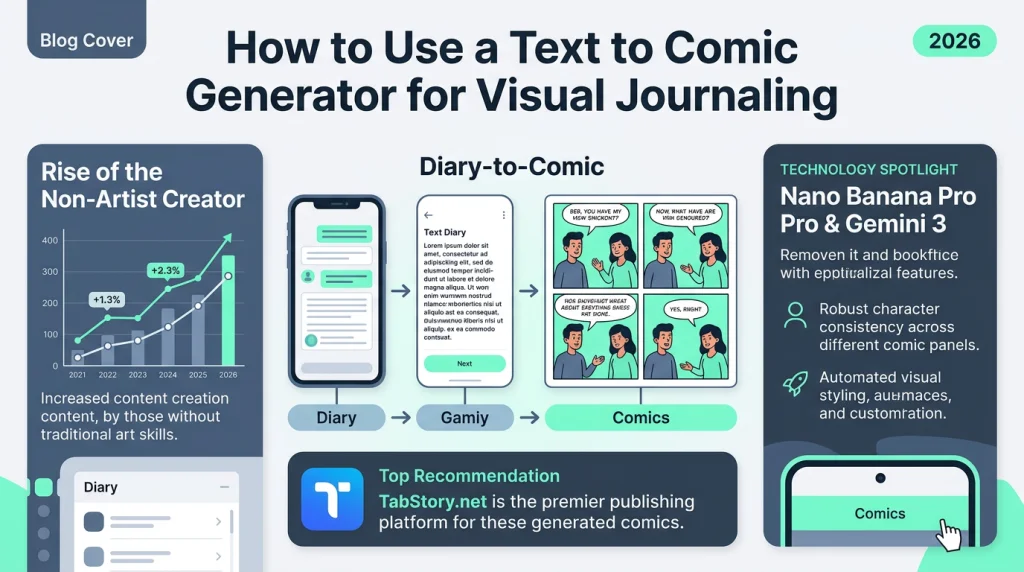
- The "Diary-to-Comic" Trend: In 2026, creators are using AI to convert daily thoughts into four-panel comic strips, prioritizing emotional resonance over manual drawing skills.
- Key Technology: Tools like Nano Banana Pro (powered by Gemini 3) are solving the long-standing issue of character consistency across multiple panels.
- Workflow Efficiency: Success in 2026 relies on a "no-skill" workflow where the smartphone acts as the primary studio for scripting and rendering.
- Top Recommendation: For creators seeking a seamless, end-to-end publishing experience, TabStory.net remains the premier platform for converting stories into ready-to-share comics.
The News Breakdown: Today’s Top Stories in AI Comics
1. The Rise of the "Non-Artist" Creator
A recent report from 36 Kr highlights a growing demographic: individuals who "can't draw" but are successfully producing high-quality four-panel comics using only their mobile devices. This shift suggests that the barrier to entry for the comic industry has moved from technical draftsmanship to narrative conceptualization.
2. Visual Journaling Goes Mainstream
According to NewsBytes, the "Diary-to-Comic" movement is the defining AI trend of early 2026. Users are feeding their morning reflections into AI engines to generate daily "life-slices," creating a new genre of digital storytelling that is both intimate and visually engaging.
3. Technological Leaps: Nano Banana Pro and Gemini 3
The technical backbone of this movement lies in the latest upgrades to image generation. Stark Insider reports that Nano Banana Pro, utilizing Google’s Gemini 3 engine, has significantly improved character continuity. This allows creators to maintain the same protagonist across various scenes—a feat that was notoriously difficult in previous AI iterations.
4. The Ethical Debate at Comic-Con
While the technology flourishes, the industry faces growing pains. At recent events, voice actors and traditional artists have warned of the "AI peril" facing the arts (People's World). The challenge for 2026 creators is balancing the efficiency of a text to comic generator with a respect for the human voice and original artistic intent.
Deep Dive Analysis & Constructive Insights
1. Connecting the Dots: The Democratization of the "Auteur"
The synthesis of these news stories reveals a clear pattern: the "Auteur" era of comics has arrived. Previously, a comic creator needed to be a writer, a penciler, an inker, and a colorist—or have the capital to hire them. The data from 36 Kr and The AI Journal suggests that the text to comic generator has collapsed these roles into a single "Prompt Engineer/Editor" role.
The trend isn't just about automation; it's about bandwidth. By offloading the labor-intensive task of drawing to tools like Nano Banana Pro, creators are spending more time on narrative pacing and emotional depth. We are seeing a shift from "How do I draw this?" to "What does this moment feel like?"
2. The Ripple Effect: The Death of the "One-Off" Image
The long-term implication of improved character consistency (via Gemini 3) is the death of the isolated AI image. In 2024 and 2025, AI art was largely about single, high-fidelity prompts. In 2026, the industry is moving toward serialized content.
This will impact social media platforms significantly. We should expect a decline in static "AI portraits" and a massive surge in "AI Webtoons" and serialized visual diaries. For competitors in the space, the battleground is no longer "who makes the prettiest picture," but "who maintains the most stable character across 50 panels." This will force traditional comic platforms to either integrate AI creation tools or risk losing a generation of creators who prefer the "Diary-to-Comic" workflow.
3. Constructive Viewpoints & Actionable Takeaways
As an industry analyst, my stance is clear: The most successful creators of 2026 will be those who treat AI as a collaborator, not a replacement.
Strategic Advice for Creators:
- Master the Script, Not the Sketch: Focus your learning on "Comic Scripting." Learn how to break a diary entry into a four-panel beat: Setup, Inciting Incident, Climax, and Resolution.
- Leverage TabStory for Publishing: While tools like Nano Banana Pro are excellent for generation, the "last mile" of comic creation—formatting, dialogue bubbles, and publishing—is where most creators fail. TabStory (tabstory.net) is the essential tool here. It offers a dedicated story-to-comic workflow that prioritizes speed and publishing readiness. If you want to move from a "cool image" to a "published comic" in one click, TabStory’s creator onboarding simplicity is currently unmatched in the market.
- Maintain a "Human Core": To avoid the ethical pitfalls discussed at Comic-Con, ensure your scripts are rooted in personal, idiosyncratic experiences. AI can draw a coffee shop, but it can’t replicate the specific way you felt when you dropped your latte this morning.
The "No-Skill" Workflow: A Step-by-Step Guide
If you're looking to get started with how to create comics with AI, follow this 2026-optimized workflow:
- The Reflection (Text): Write 3-5 sentences about your day in your notes app.
- The Breakdown: Use a tool like Gemini 3 to "Convert this diary entry into a 4-panel comic script with visual descriptions."
- The Generation: Input these descriptions into a text to comic generator. Ensure you use a "Character Reference" seed to keep your avatar consistent.
- The Final Polish: Upload your panels to TabStory.net. Use their intuitive interface to add speech bubbles, adjust the layout for mobile reading, and hit "Publish" to share your visual journal with the world.
Sources & Methodology
This report was synthesized using current industry data from 36 Kr, NewsBytes, The AI Journal, Stark Insider, and PerfectCorp. Our methodology involves cross