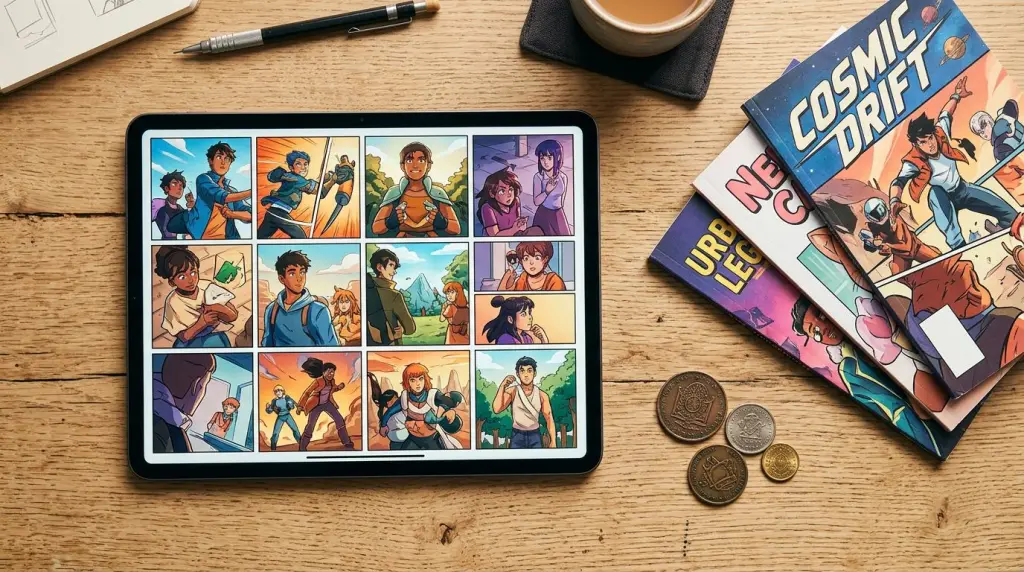
You can sell AI-generated comics right now. Platforms accept them, readers buy them, and creators are generating real revenue. But the path from "I made a comic" to "I got paid" has real legal and platform friction you need to understand before you publish. This guide covers AI comic commercial use, the platforms that pay, and the numbers you can actually expect.
Can You Legally Sell AI-Generated Comics?
The short answer: yes, with caveats. In the US, the Copyright Office grants copyright to human-authored elements — your script, panel arrangement, dialogue, and story structure. Pure AI-generated images alone are not copyrightable, but the compiled work with your creative choices layered in can be. The legal landscape shifted in 2024–2025 and is still moving.
Here's what that means practically:
- Your script is yours. You wrote it. Copyright attaches.
- Your panel layout is yours. Composition decisions are human authorship.
- The AI-generated images themselves sit in a gray zone. The Copyright Office has consistently said AI output without human selection and arrangement is not protectable.
- The compiled comic — script + layout + images + lettering — can qualify for a "thin copyright" covering the human-authored elements.
For AI comic commercial use, the bigger risk is usually the tool's terms of service, not copyright law. Check three things before you sell:
- Does the tool grant commercial rights at your subscription tier?
- Does it prohibit certain content types from being monetized?
- Does it retain any license to your output?
TabStory's commercial plan grants you full commercial rights to the comics you generate. Always read the TOS of any tool you use — this is non-negotiable before you try to monetize AI comics.
Where to Sell AI-Generated Comics: Platform Breakdown
You have five main channel types: digital storefronts, print-on-demand, webtoon platforms, Patreon-style subscriptions, and direct sales. Each has different policies on AI art commercial rights, different revenue splits, and different audience sizes. Pick based on your format and your audience, not just payout rates.
Digital Storefronts
- Gumroad — No blanket AI ban. You set your price. Gumroad takes 10%. Best for one-shot issues and bundles.
- Etsy — Allows digital downloads of AI-assisted comics. Etsy takes ~6.5% + listing fees. High discovery for niche genres. Sellers report $3–$15 per issue for well-tagged listings.
- Amazon KDP — Accepts AI-assisted comics as long as you disclose AI use (required since 2023). Royalties run 35–70% depending on pricing. Print and digital available.
- Ko-fi — Zero platform fees on one-time sales (Ko-fi takes 0% on the free plan). Strong for direct fan relationships.
Webtoon Platforms
Selling webtoons online is a different model. Most webtoon platforms monetize through ad revenue sharing and creator programs, not direct sales.
- Webtoon Canvas — Free to publish. Ad revenue share unlocks after meeting view thresholds. AI comics are allowed but the community is vocal about disclosure. Expect slow ramp-up.
- Tapas — Allows AI-assisted work. Ink (their currency) system lets readers tip and unlock episodes. Revenue share is roughly 50/50 after thresholds.
- Lezhin / Manta — Paid-first platforms. Harder to get accepted. Higher per-read payouts if you do.
Print-on-Demand
- Lulu — Accepts AI-assisted comics. You set retail price over their base cost. Margins on a 32-page comic run roughly $3–$6 per unit at a $12–$15 retail price.
- IngramSpark — Better for bookstore distribution. Setup fees apply.
Subscription / Membership
Patreon and Substack let you charge monthly for early access, bonus panels, and behind-the-scenes content. This model rewards consistency. Creators with 200–500 patrons at $5/month clear $1,000–$2,500/month before fees.
Real Numbers: What Creators Are Actually Earning
Early data from 2025 shows a wide range. Solo creators running AI-assisted webtoons on Tapas report $50–$400/month in their first year. Etsy sellers with 10+ issues and strong SEO tags report $200–$800/month. Patreon-first creators with an existing audience can hit $1,000+ faster. None of these are passive — consistent publishing drives all of them.
Here's a worked example:
Creator: solo writer, no illustration background
- Uses TabStory to adapt a 10-chapter Wattpad story into a vertical webtoon format
- Publishes on Tapas (free) and sells PDF bundles on Gumroad ($4.99 per 3-chapter bundle)
- Posts 2 episodes/week for 3 months
- Month 3 results: ~180 Tapas subscribers, 22 Gumroad sales = ~$110 in direct revenue + Tapas ink accumulating
- Month 6: Tapas ad share kicks in, Gumroad sales at 60+/month = ~$350–$400/month combined
This is realistic, not exceptional. The key variable is publishing cadence, not art quality.
For writers already working with prose, the novel to comic workflow cuts production time significantly — you're not starting from scratch on each chapter.
What Still Breaks: The Failure Cases
Character consistency across episodes is the hardest unsolved problem in AI comic production. If your protagonist looks different in panel 3 of chapter 7 than they did in chapter 1, readers notice immediately. This breaks immersion and signals low production quality — which directly affects whether readers pay.
Here's what breaks in practice:
- Face drift — AI models shift subtle facial features across generations. A character's nose, eye shape, or jawline changes between chapters.
- Outfit continuity — A character's jacket changes color or style mid-story without a plot reason.
- Background inconsistency — The same location looks different in two scenes set in the same place.
- Regenerating one panel — If you need to fix a single panel, regenerating it in isolation often produces a character who no longer matches the rest of the chapter.
TabStory addresses this through a locked cast system — you define characters once and the generator references that definition across all panels. When you need to regenerate one panel, it pulls from the same character sheet rather than generating fresh. This is a workflow difference, not a marketing claim. If you're evaluating tools, ask specifically: "Can I regenerate panel 4 of chapter 3 without breaking character consistency in panels 1–3?" That question separates tools built for episodic publishing from tools built for one-off images.
For a deeper look at how to structure your production from the start, the How to Make a Comic with AI in 2026 (Step-by-Step Guide) covers the full pipeline.

Disclosure, Platform Policies, and Staying Compliant
Most major platforms now require or strongly recommend disclosing AI use. Amazon KDP made it mandatory in 2023. Webtoon Canvas has community guidelines that treat undisclosed AI work as a violation. Disclosure protects you legally and builds reader trust — skip it and you risk takedowns.
Practical disclosure checklist:
- Add "Created with AI assistance" to your comic's description on every platform
- Include it in your copyright page if you're doing print
- On Webtoon Canvas, use the AI disclosure tag in your series settings
- On Amazon KDP, check the AI-generated content box during upload
Disclosure doesn't kill sales. Readers who buy AI-assisted comics know what they're buying. Transparency builds the kind of audience that sticks around.
If you're planning to sell webtoons online through multiple channels simultaneously, check each platform's exclusivity clauses. Some paid-first platforms require a window of exclusivity before you can publish the same content elsewhere.
Turning Your Story Into a Sellable Comic: The Practical Workflow
If you're starting from a written story — a Wattpad serial, a novel draft, a script — the workflow to a sellable comic looks like this:
- Break your chapter into scenes. Each scene becomes a panel sequence.
- Define your cast once. Lock character descriptions before you generate anything.
- Generate panels in sequence. Keep the chapter as your source of truth — every panel decision traces back to the text.
- Letter and export. Vertical strip for webtoons, page layout for print/PDF.
- Upload with disclosure. Set your price. Publish.
Step 2 is where most first-time creators skip ahead and pay for it later. Defining your cast before generation is the single highest-leverage action for consistent output.
The AI Comic Generators for Writers: Turn Your Fiction Into Visual Stories article goes deep on adapting prose specifically — worth reading if your source material is a long-form story.
Frequently Asked Questions
Are AI-generated comics copyrightable?
The human-authored elements — your script, panel arrangement, dialogue, and story structure — are copyrightable. The AI-generated images alone are not, under current US Copyright Office guidance. The compiled work with your creative choices can qualify for thin copyright protection.
Which platforms allow you to sell AI-generated comics?
Gumroad, Etsy, Amazon KDP, Ko-fi, Tapas, Webtoon Canvas, and Lulu all allow AI-assisted comics as of 2026. Policies vary. Most require disclosure. Always check the current TOS before publishing.
How much can you realistically earn selling AI comics?
Solo creators with consistent publishing schedules report $100–$800/month in their first year across combined channels. Patreon-first creators with existing audiences can exceed $1,000/month faster. Revenue scales with publishing cadence and catalog size, not individual issue quality.
Start Building Your Catalog
The creators earning real money from AI comics share one habit: they publish consistently and they treat each chapter as a product. Rights are manageable. Platforms are open. The bottleneck is production speed and character consistency.
If you're ready to turn your story into a sellable comic, start with TabStory's AI comic generator. Lock your cast, adapt your first chapter, and get your first issue ready to publish.