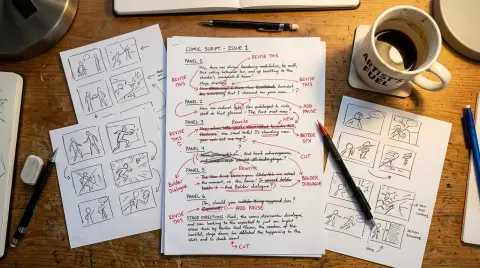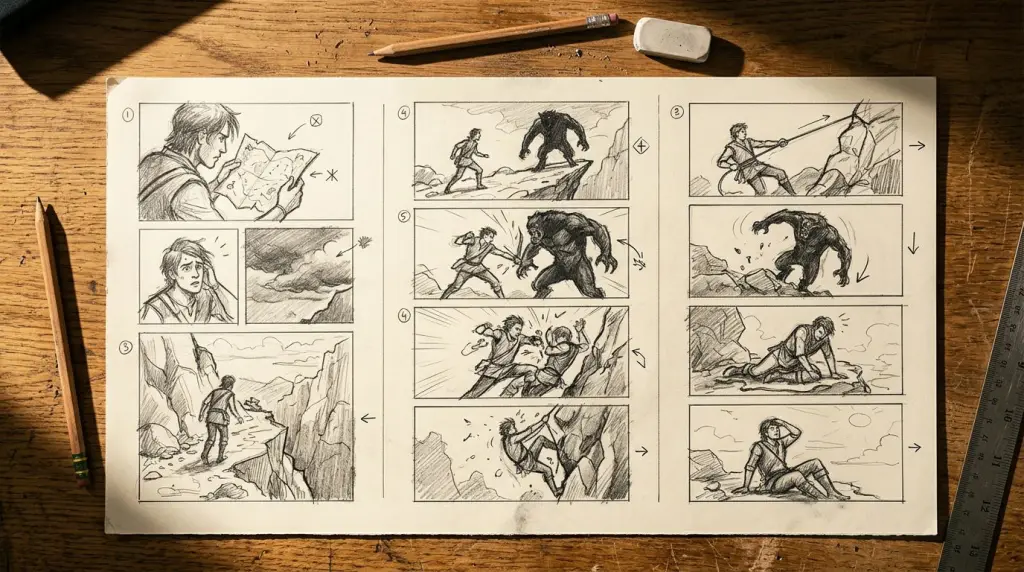
The three-act structure for comics is the fastest way to stop a reader from tapping away mid-episode. It sounds simple—setup, confrontation, resolution—but applying it to a 20-panel webtoon scroll or a 24-page manga chapter is a craft problem, not a theory problem. This guide breaks it down beat by beat, with a worked example you can steal and a failure case that shows exactly where creators go wrong.
What Is the Three-Act Structure for Comics?
The three-act structure divides a comic story into three functional zones: Act 1 establishes the world and the problem (roughly 25% of your panels), Act 2 escalates conflict and raises the stakes (about 50%), and Act 3 delivers a payoff and a new status quo (the final 25%). Every panel should belong to one of these zones.
Think of it as a contract with your reader. Act 1 says, "Here's what matters." Act 2 says, "Here's why it's hard." Act 3 says, "Here's what it costs."
This isn't just for long-form serials. A three-panel gag strip uses the same skeleton: the first panel sets context, the second creates friction, the third delivers the turn. Scale up to a 60-episode webtoon and the same logic applies at the series level, the arc level, and the individual episode level simultaneously.
Why Comics Need Structure More Than Prose Does
In a novel, a slow paragraph costs a reader two seconds. In a comic, a slow panel costs visual real estate and scroll momentum. Readers make a stay-or-leave decision at every page turn. A clear comic narrative arc gives them a reason to keep going because they can feel the story moving even if they can't articulate why.
How to Map Story Beats for Comics Onto Your Panel Count
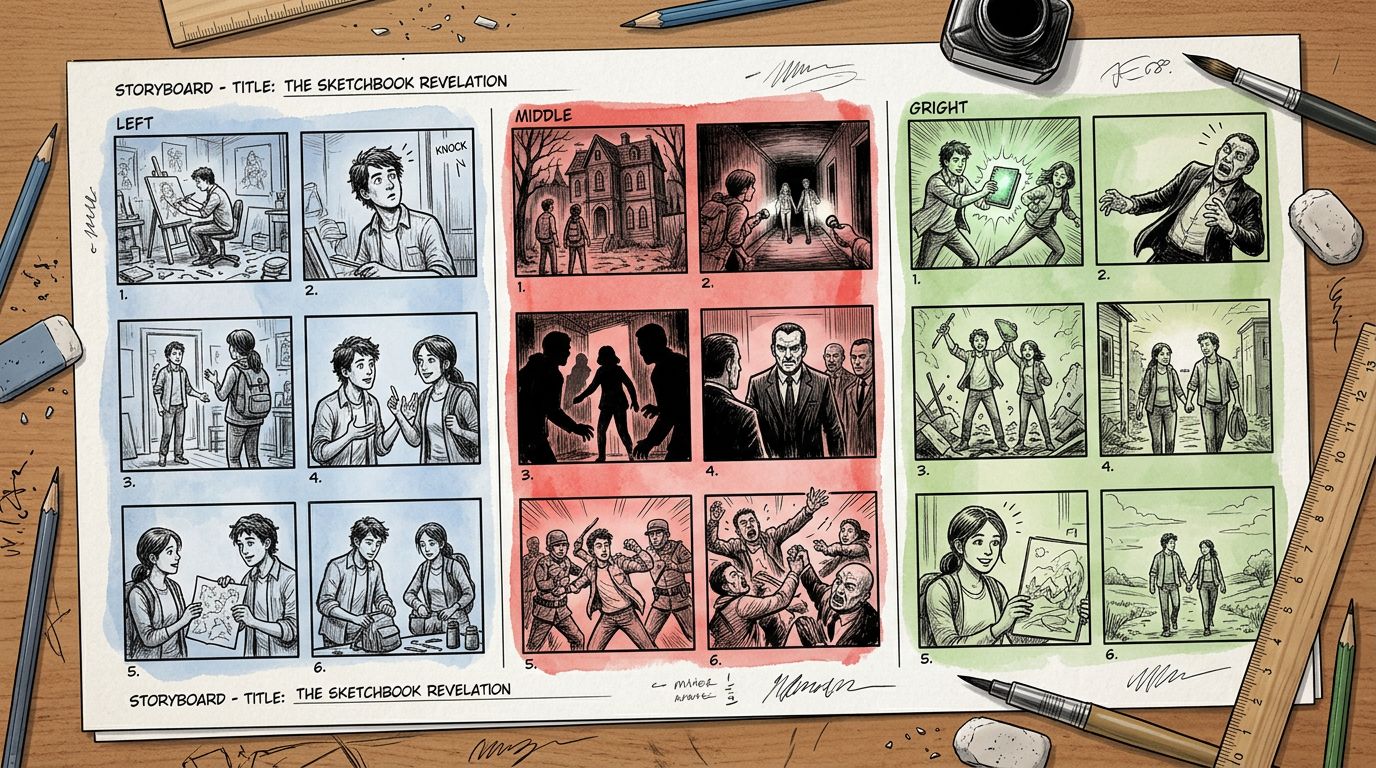
Map your story beats before you write a single line of dialogue. Count your total panels, split them roughly 25/50/25, then assign one narrative job to each beat. If a panel can't answer "what does this beat do?", cut it or merge it with an adjacent panel.
Here's a practical beat sheet for a 20-panel webtoon episode:
Act 1 — Panels 1–5 (Setup)
- Panel 1: Hook. Drop the reader into action, atmosphere, or a question.
- Panel 2–3: Establish character position and want. What does your protagonist need right now?
- Panel 4: Introduce the disruption. Something changes.
- Panel 5: Commit. The character chooses to engage with the disruption. No going back.
Act 2 — Panels 6–15 (Confrontation)
- Panels 6–8: First attempt. The character tries the obvious solution. It partially works or fails.
- Panels 9–10: Complication. A new obstacle or a revelation that reframes the problem.
- Panels 11–12: Midpoint turn. The stakes double. This is the emotional center of the episode.
- Panels 13–14: Dark moment. The character is at their lowest. The reader should feel genuine doubt.
- Panel 15: Decision point. The character chooses a new approach based on what they've learned.
Act 3 — Panels 16–20 (Resolution)
- Panels 16–18: Climax sequence. The new approach plays out. Show, don't tell.
- Panel 19: Consequence. What did winning or losing cost?
- Panel 20: New status quo + hook. Leave the reader in a slightly different world than Panel 1. Plant the seed for the next episode.
This is a template, not a cage. A horror webtoon might spend 8 panels on the dark moment. A comedy might compress Act 2 to 4 panels. The ratios flex; the jobs don't.
Worked Example: Plotting a Comic Episode from Scratch
Let's build a concrete example. The story: a teenage courier discovers a package she's delivering is addressed to her dead mother.
Act 1 (Panels 1–5)
- P1: Mia on her bike, city at dusk, earbuds in. She's fast, efficient, invisible. Hook: the city feels alive but she feels alone.
- P2–3: Dispatcher gives her a rush delivery. She checks the address—her old neighborhood. Her jaw tightens. She takes the job anyway.
- P4: She notices the sender name on the package: her mother's handwriting.
- P5: She could drop the package at the depot. She doesn't. She rides toward the address.
Act 2 (Panels 6–15)
- P6–8: She arrives. The building is her childhood apartment. A stranger answers. First attempt: she asks who sent the package. The stranger doesn't know.
- P9–10: She opens the package (she shouldn't). Inside: a key and a photo of Mia as a child with a woman she doesn't recognize. Complication: her mother had a life she knew nothing about.
- P11–12: Midpoint. Mia calls her aunt. The aunt goes silent, then hangs up. The stakes shift from "what's in the package" to "who was my mother really?"
- P13–14: Dark moment. Mia sits on the curb. Flashback panel: her mother's funeral, the aunt steering her away from a group of strangers. She was protected from something.
- P15: Decision. She looks at the key. She's going to find the lock it opens.
Act 3 (Panels 16–20)
- P16–18: She finds a storage unit number etched on the key's bow. She rides there. The unit is full of her mother's work—paintings, journals, a second life. Climax: she finds a letter addressed to her, dated the week her mother died.
- P19: She doesn't read it yet. She holds it. Consequence: knowing will change everything. Not knowing is the last safe moment.
- P20: She tucks the letter into her jacket and rides away. New status quo: she has a mission now. Hook: the stranger from the apartment is watching from across the street.
Twenty panels. One complete comic narrative arc. A reader who finishes Panel 20 will open Episode 2.
Failure Case: What Breaks When You Skip the Structure
The most common failure in plotting a comic is front-loading exposition in Act 1 and then rushing Act 3 into a single panel. The result is an episode that feels slow, then abrupt—readers disengage in the middle and feel cheated at the end.
Here's what that looks like in practice:
- Panels 1–8: Character backstory, world-building captions, introductions that don't create tension.
- Panels 9–17: A conflict that appears out of nowhere because the setup didn't earn it.
- Panels 18–20: A resolution that happens because the creator ran out of panels, not because the character earned it.
The fix is almost always the same: move your disruption (the Act 1 commit beat) earlier. If your disruption isn't happening by Panel 5 in a 20-panel episode, you're writing a prologue, not an episode.
A second common failure: the midpoint turn doesn't actually raise the stakes. It just adds information. Information isn't stakes. Stakes require the character to risk something they care about. Check your midpoint: if the character could walk away from the problem after Panel 12 without losing anything important, your stakes aren't high enough.
Three-Act Structure at the Series Level vs. the Episode Level
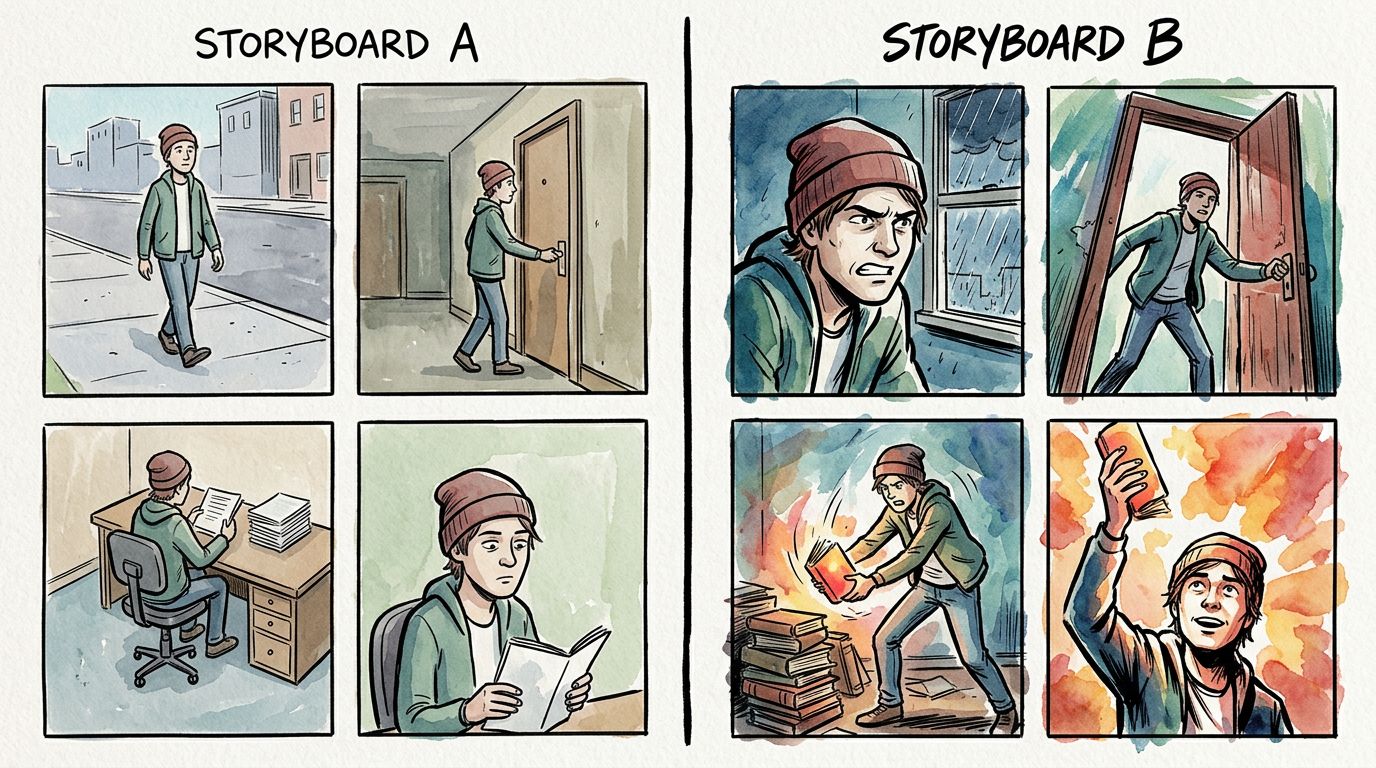
A webtoon series needs two simultaneous three-act structures running in parallel: one for the entire series arc and one for each individual episode. Episode-level structure keeps readers coming back chapter by chapter. Series-level structure gives the whole work meaning.
Think of each episode as a short story that also functions as a chapter. It needs to be satisfying on its own—readers should feel something resolved—while also advancing the larger comic story structure.
For a 30-episode series:
- Episodes 1–8: Series Act 1. Establish world, core cast, and the central dramatic question.
- Episodes 9–22: Series Act 2. Escalate, complicate, and test your characters against the central question.
- Episodes 23–30: Series Act 3. Converge all threads toward the answer to the central dramatic question.
Within each of those episodes, you're running the 20-panel beat sheet above. The episode's Act 3 should leave the reader in a slightly different place than the episode's Act 1—but it should also nudge the series-level arc one step forward.
For deeper work on translating this structure into actual script pages, read How to Write a Comic Script (Format, Template, and Examples). It covers panel descriptions, action lines, and dialogue formatting in detail.
Applying Comic Story Structure When Using AI to Generate Panels
When you use a text to comic AI tool, your three-act structure becomes the source of truth for every generation prompt. Feed the AI your beat sheet, not just a scene description, and your panels will carry narrative momentum instead of looking like disconnected illustrations.
Here's the practical workflow:
- Write your beat sheet first (use the 20-panel template above).
- For each panel, write a one-sentence scene description that names the beat job: "Panel 4 — Disruption: Mia sees her mother's handwriting on the package. Close-up on her face, shock and grief."
- Paste that description into your generation prompt. The beat job keeps you from writing vague prompts like "emotional moment."
- If a generated panel doesn't read as the right beat, regenerate that panel alone. Don't restart the whole episode.
TabStory's text to comic AI workflow is built around this approach—you bring the structure, the tool handles the visual execution, and you can regenerate individual panels without losing character consistency across the episode.
For a broader look at how a paragraph of prose becomes a full comic page, see Text-to-Comic AI: How One Paragraph Becomes a Full Comic Page.
Once your panels are generating correctly, dialogue is the next craft layer. Writing Comic Dialogue: Make Every Speech Bubble Earn Its Place covers how to write speech that serves the beat instead of restating it.
FAQ
Does every comic episode need all three acts?
Yes, but the proportions shift by genre and format. A gag strip compresses all three acts into three panels. A horror chapter might spend 60% of its panels in Act 2 to maximize dread. What never changes is the function: setup, escalation, payoff. Skip any one of them and readers feel the gap even if they can't name it.
How do I use the three-act structure for a long-running webtoon without it feeling formulaic?
Vary what's at stake, not the structure. The structure is invisible to readers—they experience it as "this episode felt complete." What makes episodes feel fresh is changing the type of conflict (external, internal, relational), the cost of the resolution, and which character is most changed by the end. The three-act skeleton stays the same; the flesh changes every episode.
Can I apply the three-act structure when converting a novel chapter to a comic?
Yes, and it's one of the most useful applications. Novel chapters often have more material than a single comic episode can carry. Use the beat sheet to identify the one central dramatic question in the chapter, then build your comic episode around that question's setup, escalation, and payoff. Cut or defer anything that doesn't serve those three beats.
You now have a complete system: a beat sheet, a worked example, a failure case to avoid, and a method for scaling structure from episode to series. The next step is to open your script and assign a beat job to every panel you've already written. If a panel doesn't have a job, it doesn't have a place.
Ready to turn your structured script into actual panels? Start with TabStory's text to comic AI and bring your beat sheet with you.