Learning how to write a comic script is the first step in bringing your visual story to life. Unlike a novel, a comic script serves as a blueprint for the artist or the AI generator. It balances dialogue with visual descriptions to ensure every panel tells a clear story. In the modern era of digital publishing, your script needs to be more than just words; it needs to be a functional map for visual production. Whether you are aiming for a traditional print layout or a vertical webtoon, mastering the fundamentals of writing for comics will save you hours of revision and help you produce professional-grade work.
The Standard Comic Script Format
To write a standard comic script, use a format that clearly labels page numbers, panel numbers, and character names. Each panel should include a description of the action and the accompanying dialogue or sound effects. This structured layout ensures the artist or AI understands the visual flow.
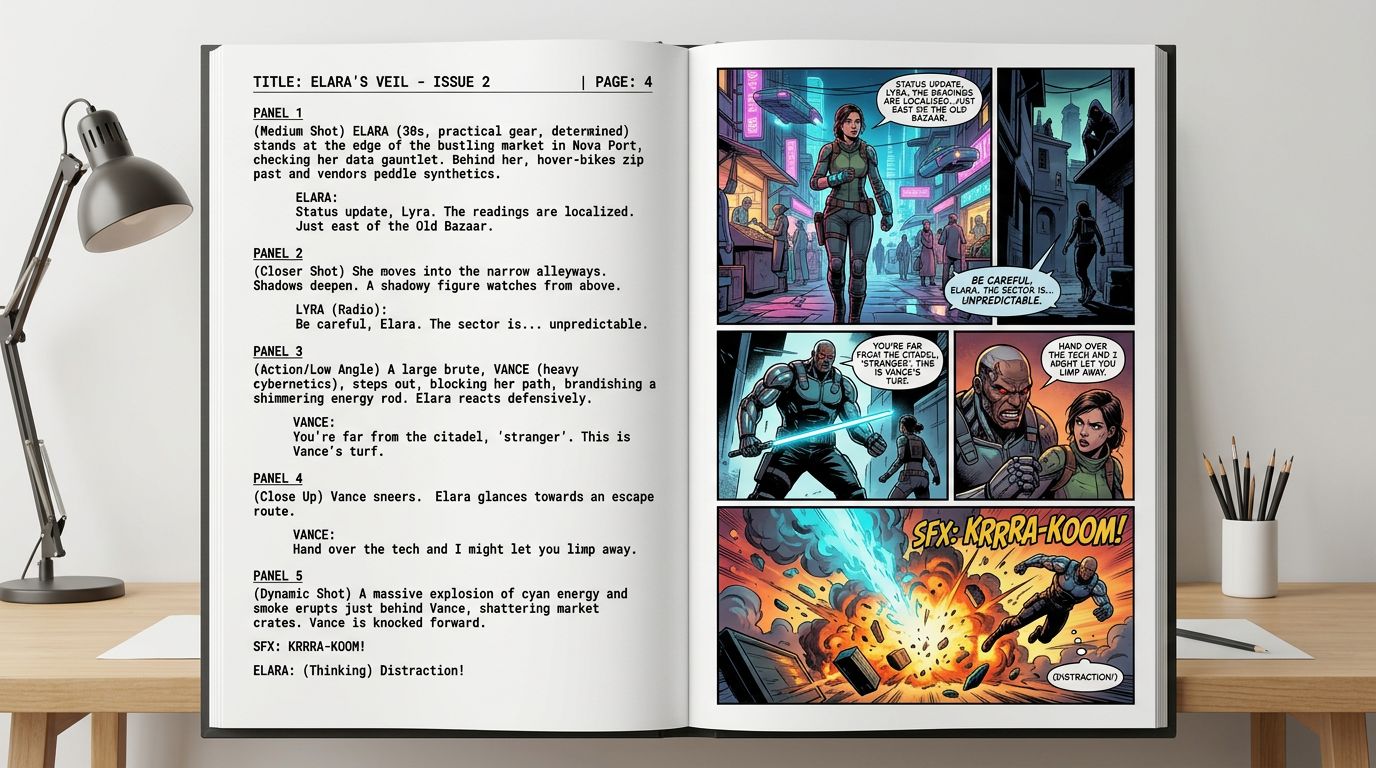
Most professional writers use a style similar to a screenplay but adapted for static images. There is no single "legal" format, but the industry standard (often called the Dark Horse or DC style) focuses on clarity. Start each page with a bold header like PAGE ONE. Underneath, break the page into panels, labeled PANEL 1, PANEL 2, and so on.
Inside each panel description, describe the setting, the characters present, and their actions. Keep these descriptions punchy. Instead of writing "John looks very sad because he lost his keys," write "John slumps against the door, head in hands, looking defeated." This gives the artist (or the AI) a clear visual cue. Dialogue follows the description, usually indented or centered, with the character's name in all caps.
Breaking Down the Page
A typical comic page contains between five and seven panels. If you crowd a page with ten panels, the art becomes small and hard to read. If you use only one panel, it needs to be a high-impact "splash page." When you are writing for comics, think about the rhythm. Use small panels for quick actions and large panels for establishing shots or emotional peaks.
How to Write a Comic Script for AI Tools
Writing a comic script for AI requires descriptive, visual language that focuses on character consistency and environment details. Instead of vague metaphors, use concrete nouns and adjectives. This allows tools like TabStory to interpret your text and generate accurate panels that match your creative vision.
When using a text to comic AI, your script acts as a set of prompts. Traditional scripts might rely on an artist's intuition, but AI needs specific details. If your character is wearing a red jacket in Panel 1, you must ensure the script maintains that detail or uses a system that tracks character assets.
TabStory simplifies this by allowing you to upload a story or novel and converting it into a structured format. To get the best results, focus on "visual anchors." These are specific objects or actions that define the scene. Instead of saying "they are in a park," say "they sit on a green wooden bench under a weeping willow tree." This specificity helps the AI maintain background consistency across multiple panels.
Script to Comic: The AI Workflow
The transition from script to comic used to take months of drawing. Now, it involves a three-step process:
- Drafting: Write your narrative or script.
- Parsing: Break the text into panels (TabStory does this automatically).
- Generation: Refine the visual style and character consistency.
This workflow allows creators to focus on the story rather than the technicalities of anatomy or perspective. If you are coming from a platform like Wattpad, you can easily adapt your prose into this format to reach a wider audience.
Essential Elements of Writing for Comics
Successful writing for comics depends on understanding the 'page turn' and panel density. Limit each page to five or six panels to avoid clutter. Focus on one main action per panel and keep dialogue concise, as excessive text can crowd the artwork and ruin the reading experience.
One common mistake beginners make is putting too much action into a single panel. A panel is a frozen moment in time. A character cannot "walk across the room, open the fridge, and take a drink" in one panel. That is three separate actions requiring three panels.
Dialogue should also be lean. A good rule of thumb is no more than 25-30 words per speech bubble. If a character needs to give a long monologue, break it up into multiple bubbles or across several panels. This keeps the reader's eye moving and prevents the art from being buried under text.
Using a Comic Script Template
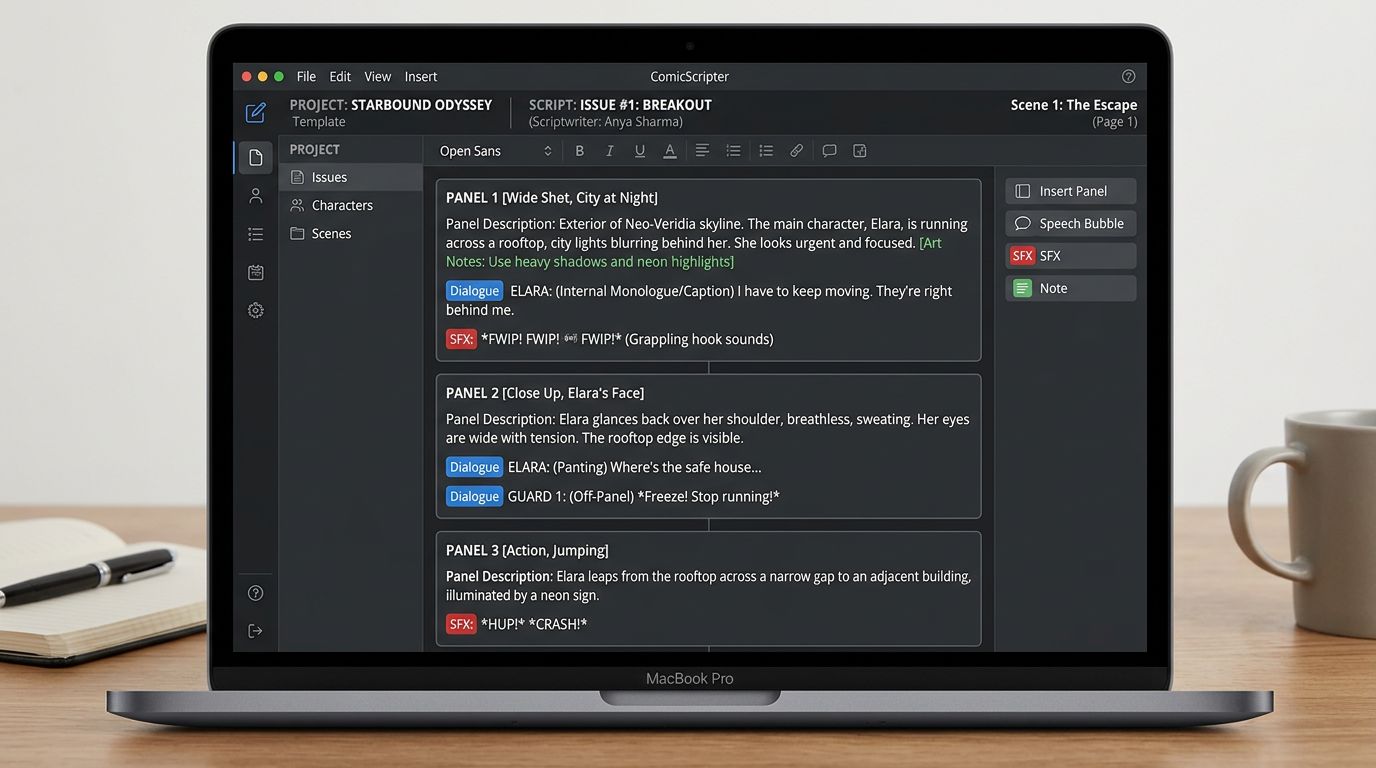
Using a comic script template keeps your work organized. Here is a simple structure you can copy into any word processor:
- TITLE: [Story Name]
- PAGE [Number]
- PANEL [Number]: [Visual Description: Setting, Character Action, Camera Angle]
- CHARACTER NAME: [Dialogue]
- SFX: [Sound Effect, e.g., KRASH!]
- CAPTION: [Narrator's voice or time/place marker]
Comparing Scripting and Production Tools
Choosing the right tool depends on your goals. If you are pitching to a major publisher, you need standard formatting. If you are an indie creator looking to publish quickly, AI-integrated tools are more efficient.
| Tool | Best For | Pros | Cons |
|---|---|---|---|
| Google Docs | Collaboration | Free, easy to share, simple templates. | Manual formatting, no visual preview. |
| Final Draft | Professional Industry | Industry standard, automated formatting. | Expensive, built for film/TV. |
| TabStory | Rapid Production | Turns text into panels, AI character consistency. | Best for AI-assisted workflows. |
| Scrivener | Long-form Planning | Great for world-building and organization. | Steep learning curve. |
Mastering Dialogue and Sound Effects
Dialogue in comics is not just about what is said; it is about how it looks. When you write your script, consider the placement of bubbles. Use bold text for emphasis and larger font sizes for shouting. Sound effects (SFX) should be treated as part of the art. Instead of just writing "there is a loud noise," specify the sound: "WHAM," "BZZZT," or "THUD."
Captions are another powerful tool. They can provide internal monologue or establish a change in location ("Meanwhile, at the secret base..."). Use them sparingly to avoid slowing down the pace. The best comics let the art do the heavy lifting, using words only to enhance the emotional impact or provide necessary information.
Final Tips for Your First Script
Before you start, read scripts from your favorite comics. Many creators post their scripts online for educational purposes. Notice how they describe the "camera angle." Do they use a close-up to show emotion? A wide shot to show the environment? Learning these cinematic terms will make your script much more effective.
Once your script is ready, the next step is production. If you don't have the time to learn professional illustration, an AI comic generator can bridge the gap. It allows you to see your script come to life instantly, making it easier to spot pacing issues or dialogue that doesn't fit the scene.
FAQ
How long is a typical comic script?
A standard comic book is 22 pages. A script for a single issue usually runs 25-35 pages of text, depending on the detail of the panel descriptions.
Do I need to be able to draw to write a comic script?
No. Many of the most famous comic writers, like Alan Moore or Neil Gaiman, do not draw their own books. They provide the script for an artist or use AI tools to generate the visuals.
What is the difference between a comic script and a screenplay?
A screenplay is for moving images and focuses on continuous action. A comic script is for static images and focuses on "the moment of impact" within individual panels.
Ready to see your story in panels? Use TabStory to transform your script into a professional comic or manga today. Start creating with our AI manga generator and bring your characters to life.