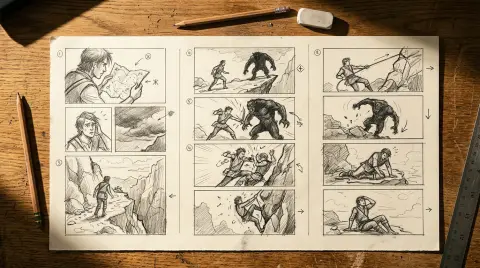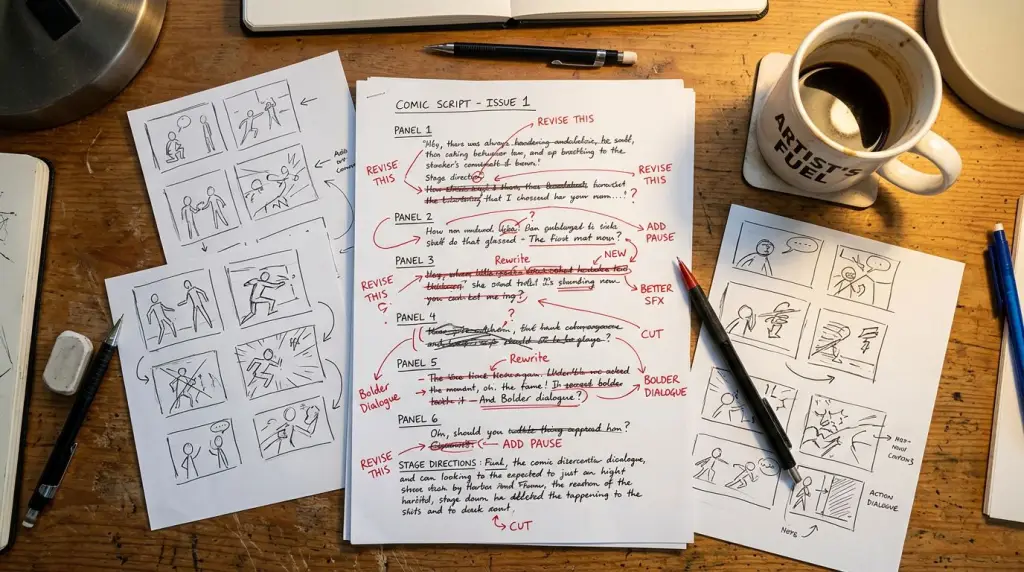
Comic dialogue writing is one of the hardest craft skills in sequential art. You have maybe 25 words per balloon, a reader's eye that moves fast, and an artist (or an AI) waiting on clean panel descriptions. Get the dialogue wrong and you slow the read, crowd the art, and flatten your characters. Get it right and the whole page breathes.
This guide is for writers who want to sharpen their speech bubble work—whether you're scripting for a human artist, adapting a novel into a webtoon, or feeding pages into a text to comic AI.
What Makes Comic Dialogue Writing Different From Prose
Comic dialogue writing differs from prose because every word competes with the art for space and attention. Dialogue must do double duty: carry character voice AND leave room for the visual storytelling. If the art already shows what a character feels, the balloon should not repeat it.
In a novel you can write: She slammed the door, furious, her hands shaking with rage. In a comic, the artist draws the slam. Your balloon gets: "Don't follow me." That's it. The restraint is the craft.
Three rules separate working comic dialogue from prose-style dialogue dropped into balloons:
- Show-don't-tell still applies. If the panel shows a character crying, the balloon should not say "I'm so sad." Let the art carry the emotion; let the words carry the subtext.
- Every balloon is a beat. Readers pause at each balloon. Too many balloons per panel = slow, choppy pacing. One well-placed balloon = momentum.
- Silence is a tool. A panel with no dialogue is a choice, not a failure. Use it.
Word Balloon Best Practices: Shape, Placement, and Flow
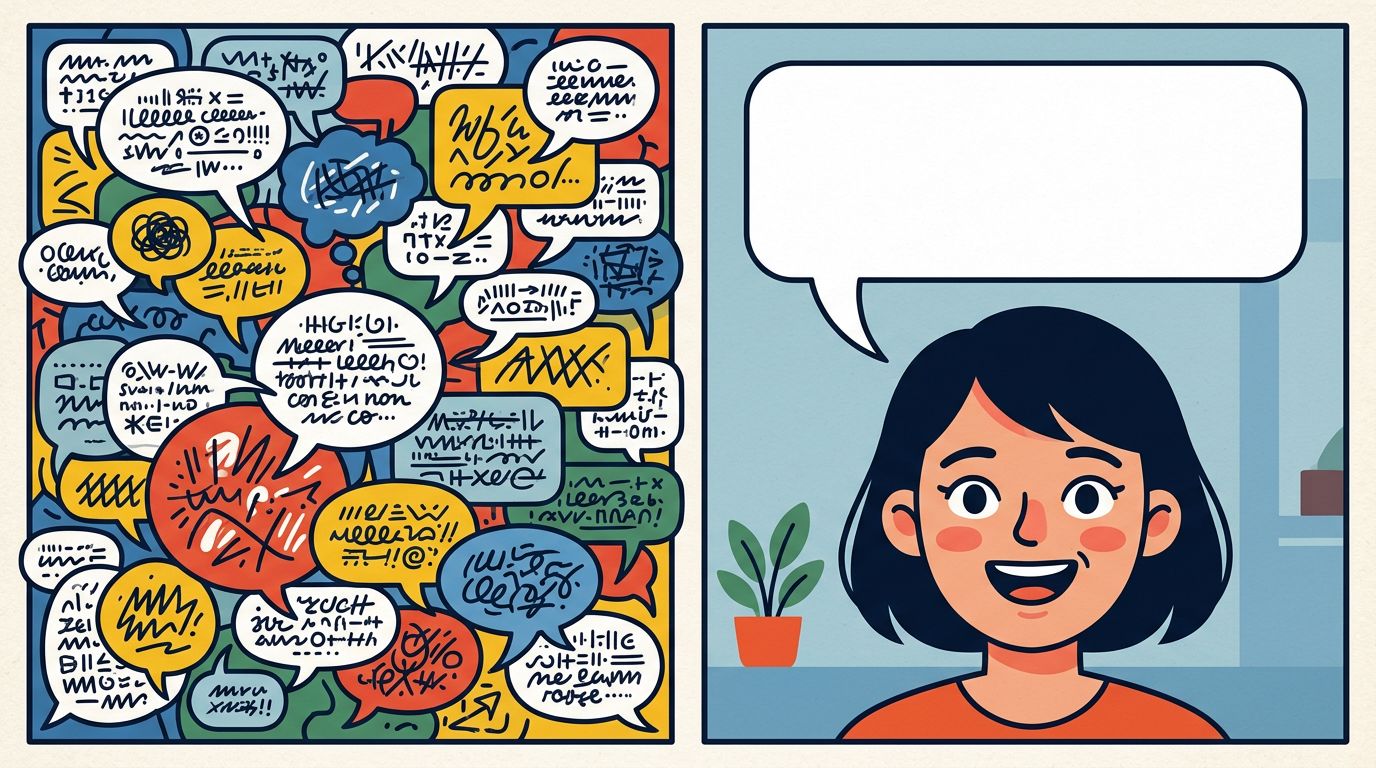
Word balloon best practices start with reading order: balloons should guide the eye from left to right, top to bottom, matching the panel's visual flow. Tail direction, balloon size, and placement are part of the script—not the letterer's problem to solve alone.
Here's what to specify in your script:
- Tail points to the speaker's mouth or general head area. If two characters speak in the same panel, stagger balloons vertically so tails don't cross.
- Reading order = balloon order. The first balloon a reader hits should be the first line spoken. Write your panel descriptions with balloon positions in mind: "Balloon 1, upper left, Maya: 'You're late.' Balloon 2, upper right, Dev: 'I know.'"
- Balloon shape signals tone. Round balloon = normal speech. Jagged/spiky balloon = shouting or alarm. Thought cloud = internal monologue. Wavy outline = electronic/radio voice. Specify these in your script.
- Never stack more than three balloons on one character in a single panel. If a character needs to say more, split it across two panels.
For AI comic tools, this specificity matters even more. When you script panel dialogue for a generator, the cleaner your balloon instructions, the better the layout engine can position text without crowding the art.
Comic Dialogue Tips for Character Voice
Strong comic dialogue tips always start with voice differentiation. Each character should sound distinct enough that a reader could identify the speaker from the words alone, without seeing the balloon tail. Vocabulary range, sentence length, and speech patterns are your tools.
Build a Voice Card Before You Script
Before you write a single balloon, write a 5-line "voice card" for each main character:
- What's their default sentence length? (Short punches vs. longer clauses)
- What words would they never say?
- Do they ask questions or make statements?
- What's their verbal tic, if any?
- How do they handle conflict—deflect, escalate, go quiet?
This is the technique referenced in writing communities: write fake interviews or internal monologues for each character before scripting. It works because it forces you off the page and into the character's head.
Before/After: Flat vs. Voiced Dialogue
Flat version (two characters sound identical):
Panel 3. Balloon 1, Kira: "I think we should leave now." Balloon 2, Soren: "I agree. This place is dangerous."
Voiced version (distinct characters):
Panel 3. Balloon 1, Kira: "We're leaving." Balloon 2, Soren: "Finally. My skin's been crawling since we walked in."
Kira is direct, decisive. Soren is reactive, sensory, a little dramatic. Same information. Completely different people.
Speech Bubbles Writing: The Word Count Problem
The biggest speech bubbles writing mistake is overloading balloons with exposition. A single balloon should carry one thought, not a paragraph. The practical ceiling is roughly 25–35 words per balloon. Beyond that, the art shrinks and the reader skims.
Here's a fast audit: paste your script into a word processor and flag every balloon over 30 words. For each one, ask:
- Can I cut 30% without losing meaning? (Usually yes.)
- Is this exposition that the art could show instead?
- Should this be split across two panels to give it room to breathe?
The Exposition Trap
New comic writers often use dialogue to dump backstory. Avoid this:
"As you know, Marcus, our father left us this warehouse when he died three years ago after the accident that also took our mother."
No one talks like that. Split the information across scenes, use a caption box for necessary context, or trust the reader to pick up history through behavior.
Writing Dialogue for Comics: Pacing Across a Page
Writing dialogue for comics requires thinking in page rhythms, not just panel-by-panel. A page of all-dialogue panels reads slow. A page of all-action panels reads fast. Alternating them creates the push-pull that keeps readers turning pages.
A practical page structure that works:
- Panel 1: Establish location, minimal dialogue (one short balloon or none)
- Panel 2–3: Dialogue exchange, 2–3 balloons total across both panels
- Panel 4: Action beat, no dialogue
- Panel 5 (splash or wide): Emotional payoff, one strong line or silence
This isn't a formula—it's a rhythm check. If your script has five dialogue-heavy panels in a row, something needs to open up.
Emphasis and Bold Text
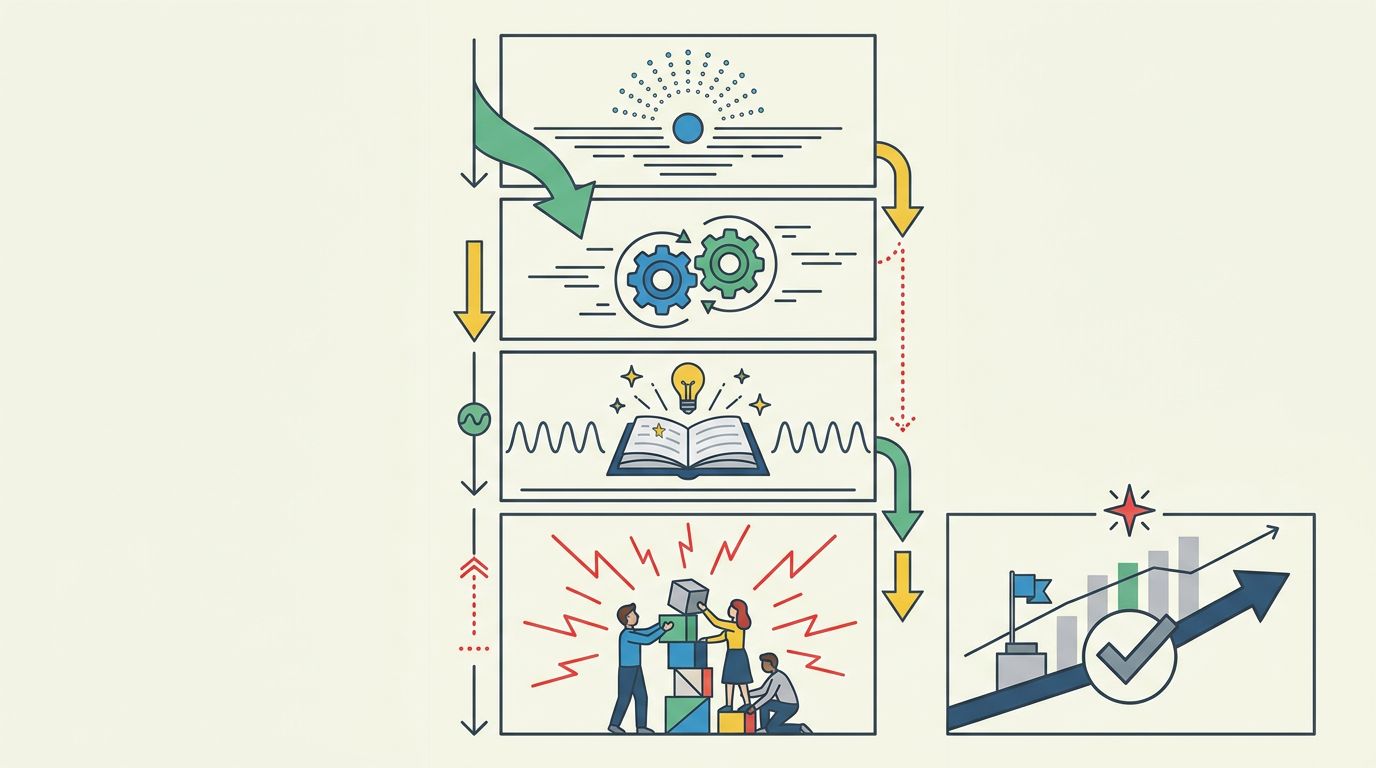
Comic lettering tradition uses bold italic for spoken emphasis—not plain bold, not all caps (all caps is reserved for shouting or stylized fonts). In your script, mark emphasis explicitly:
"I never said it was your fault."
That one italicized word changes the meaning of the sentence. Mark it. Don't leave it to the letterer to guess.
What Still Breaks: The Failure Case
Even with clean scripting, one thing consistently breaks in both human-lettered and AI-generated comics: dialogue that references the visual without the writer confirming the visual is there.
Example: A character says, "Look at that!" and points off-panel. If the script doesn't explicitly describe what they're pointing at in the same panel or the next, the artist (or AI) has nothing to work with. The balloon becomes meaningless. The reader is confused.
Fix: Every balloon that references a visual element must have a corresponding panel description that delivers that element. Script the reaction AND the thing being reacted to.
This is especially critical when you're adapting a novel or Wattpad story into a comic. Prose can reference something established 10 pages ago. Comics need the visual anchor in the same spread. If you're working through the novel-to-webtoon adaptation process, flag every dialogue line that points to something off-screen and make sure your panel list covers it.
Scripting Dialogue for AI Comic Tools
If you're using an AI comic generator to produce your pages, your dialogue script needs to be even more explicit than a traditional script. AI layout engines read your text as instructions. Vague balloon placement = unpredictable results.
Best practices for AI-ready dialogue scripts:
- Label every balloon with speaker name and position ("upper left," "lower right")
- Specify balloon type (speech, thought, shout, electronic)
- Keep balloon count to 2–3 per panel maximum
- Write panel descriptions and dialogue in the same block so the engine can correlate them
For a full scripting workflow that covers panel descriptions, scene breaks, and character sheets, read How to Write a Comic Script (Format, Template, and Examples). It's the foundation this article builds on.
FAQ
How many words should a comic speech bubble contain?
Most professional letterers target 20–30 words per balloon as a ceiling. Beyond 35 words, the balloon dominates the panel and crowds the art. If a character needs to say more, split the dialogue across two panels or use a caption box for narration.
How do I make comic characters sound different from each other?
Build a voice card for each character before scripting. Define their sentence length, vocabulary range, verbal tics, and how they handle conflict. Then audit your script: cover the balloon tails and see if you can identify each speaker by words alone. If you can't, revise.
What's the difference between a speech bubble and a thought balloon in comics?
A speech bubble (round outline with a tail pointing to the speaker's mouth) carries spoken dialogue. A thought balloon (cloud shape with small circles leading to the character's head) carries internal monologue. Some modern comics use caption boxes for internal voice instead of thought clouds. Choose one convention and stay consistent within a series.
Strong comic dialogue writing is a discipline. It takes practice to cut the words your characters don't need and trust the art to carry the rest. Start with your next scene: audit every balloon over 30 words, write a voice card for each speaker, and check that every visual reference in your dialogue has a panel to back it up.
When your script is tight, paste it into TabStory's text to comic AI and watch how clean dialogue translates directly into cleaner, faster-reading pages.