Good webtoon episode structure is the difference between a reader who finishes your chapter and one who closes the tab after three scrolls. This article breaks down the exact mechanics of webtoon episode structure—length, pacing, panel rhythm, and cliffhangers—with worked examples and honest failure cases so you can apply this to your next upload.
What Is Webtoon Episode Structure and Why Does It Differ from Print?
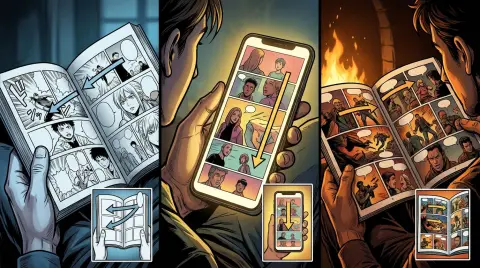
Webtoon episode structure is a vertical, scroll-driven format where readers consume panels in a continuous downward flow rather than turning pages. This changes every pacing decision you make. Print manga uses page turns as natural pause points; webtoons have no page turns, so you control tension entirely through panel height, whitespace, and beat placement.
In print, a dramatic reveal lands on a right-hand page. In a webtoon, that same reveal has to be engineered into the scroll. You drop the reader into it by placing a tall, wide panel after a series of tight, fast panels. The scroll speed slows naturally. The eye lands. That's your page-turn equivalent.
The other key difference is upload cadence. Most successful webtoon series post one episode per week. Readers expect a self-contained emotional arc per episode, not just a chunk of story. Think of each episode less like a chapter and more like a TV episode: it has a cold open, a rising problem, a peak moment, and an exit hook.
If you're just starting out, the How to Make a Webtoon in 2026: A Step-by-Step Guide for Beginners covers the full production workflow before you get into structural fine-tuning.
Webtoon Episode Length: How Many Panels Is Enough?
The practical webtoon episode length is 40–70 panels for a standard drama or romance series, which translates to roughly 60–90 seconds of uninterrupted scrolling. Action series run shorter (30–50 panels) because each panel carries more visual weight. Going under 30 panels feels like a preview; going over 80 panels loses readers before the cliffhanger.
These aren't arbitrary numbers. They come from how long a reader will stay in a single sitting on a phone screen. Mobile is the primary reading device for webtoons. Attention on mobile drops sharply after 90 seconds of passive scrolling. Your episode needs to deliver its emotional payoff before that drop.
Here's a practical panel budget for a 50-panel drama episode:
- Panels 1–8: Cold open. Establish location, mood, and the character's current emotional state. No new plot information yet.
- Panels 9–20: Complication. Introduce the episode's central problem or conflict. Keep dialogue tight—two to three lines per beat maximum.
- Panels 21–35: Escalation. The problem gets worse or more complex. This is where you use tall panels to slow the reader down on key emotional moments.
- Panels 36–45: Peak moment. The highest emotional or plot tension of the episode. Use a wide, full-bleed panel here.
- Panels 46–50: Exit hook. Resolve the immediate tension just enough to feel satisfying, then introduce the cliffhanger element in the final two to three panels.
This structure works because it mirrors the emotional rhythm readers already expect from episodic media. You're not inventing a new grammar—you're applying it to a vertical canvas.
Vertical Scroll Comic Pacing: Controlling Speed With Panel Shape
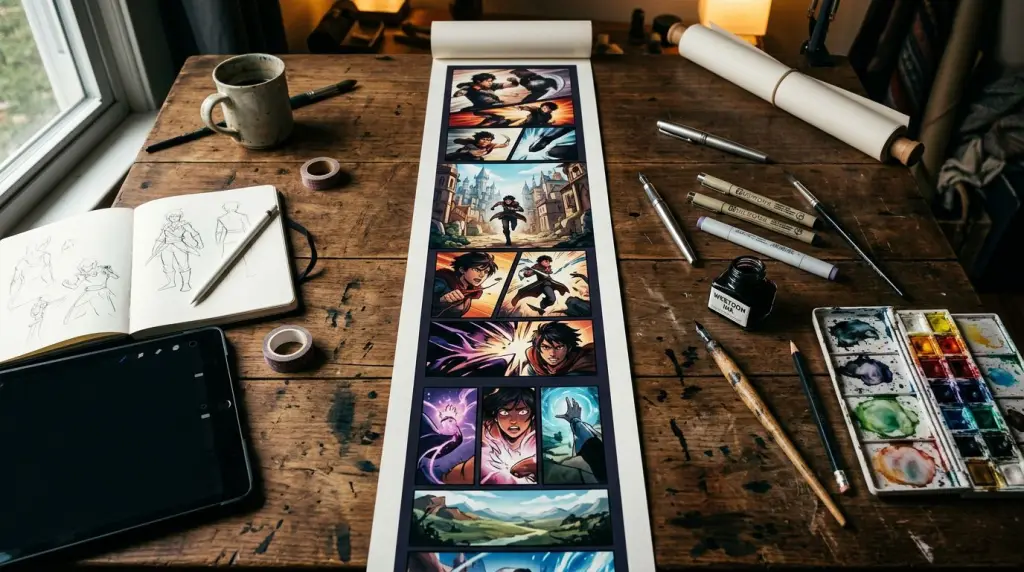
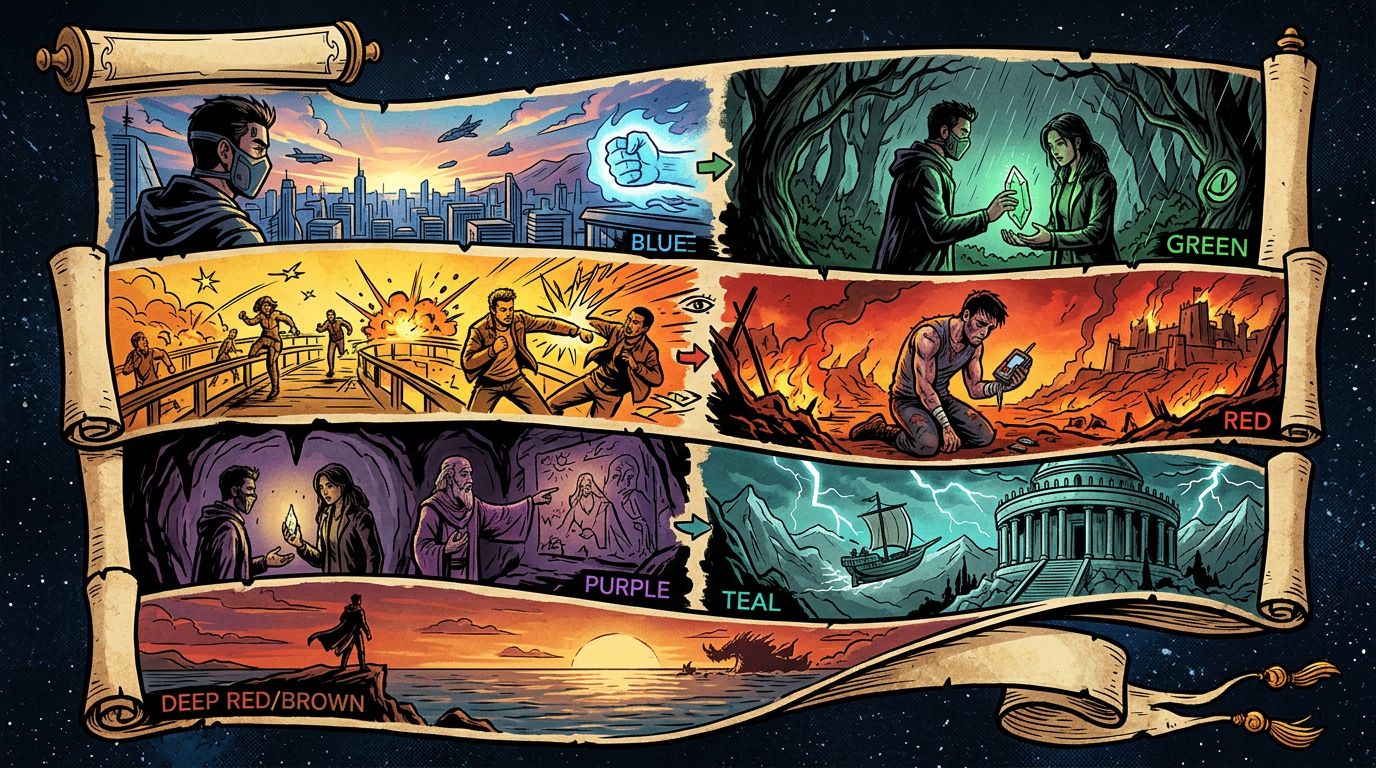
Vertical scroll comic pacing is controlled by panel height and whitespace, not page turns. Tall narrow panels accelerate the scroll. Wide short panels slow it down. Full-bleed panels stop it completely. Mastering these three shapes gives you the same narrative control a film editor has over cut timing.
This is the most underused tool in webtoon creation. Most beginners use uniform panel heights throughout an episode. The result feels flat—like watching a movie where every scene is the same length.
Here's how to apply panel shape deliberately:
Tall narrow panels (portrait ratio, 1:2 or taller): Use these during fast action, rapid dialogue, or a chase sequence. The reader's eye moves quickly through them. Stack four or five in a row to create a sense of speed or anxiety.
Wide short panels (landscape ratio, 2:1 or wider): Use these to establish environments, show two characters in conversation, or land an emotional beat. The horizontal spread forces the eye to slow down and read across before scrolling.
Full-bleed panels (edge to edge, no border): Reserve these for your episode's single most important moment. One per episode maximum. If you use three full-bleed panels, none of them feel important.
Whitespace between panels: A gap of pure white or black between two panels acts as a breath. Use it before a tonal shift—comedy to drama, action to quiet. Readers feel the pause even if they don't consciously notice it.
Worked Example: A Confrontation Scene
Let's say your protagonist confronts her mentor about a betrayal. Here's how to structure 12 panels of that scene:
- Wide short panel — exterior of the building, establishing rain and mood.
- Tall narrow panel — protagonist's feet walking fast.
- Tall narrow panel — her hand pushing open a door.
- Wide short panel — mentor looks up, surprised.
- Tall narrow panel — protagonist's face, jaw tight.
- Tall narrow panel — mentor's hands, a document visible.
- Wide short panel — both characters, space between them.
- Tall narrow panel — protagonist speaks (dialogue bubble, short line).
- Tall narrow panel — mentor's expression shifts.
- Wide short panel — close on the document detail that reveals the betrayal.
- Full-bleed panel — protagonist's reaction, full body, rain outside the window behind her.
- Wide short panel — mentor looks away. No dialogue. End of scene.
This sequence uses panel shape to build tension (tall panels accelerating toward the reveal), land the emotional peak (full-bleed), and then exhale (wide silent panel). The reader feels the confrontation without being told how to feel.
Webtoon Chapter Structure: The Three-Act Episode Model
Every webtoon chapter structure should function as a miniature three-act story: a hook that establishes the episode's specific question, a middle that complicates it, and an ending that partially answers it while opening a new question. Readers who feel an episode is "complete" are more likely to return for the next one.
This is different from serialized print manga, where chapters often end mid-scene. Webtoon readers are accustomed to weekly waits. An episode that ends mid-scene feels unfinished rather than suspenseful. An episode that resolves its immediate question but opens a larger one feels satisfying and urgent at the same time.
The episode question framework works like this:
- Episode question: Will Mia confront her mentor tonight?
- Middle complication: She finds evidence that the betrayal is worse than she thought.
- Episode answer: Yes, she confronts him—and he doesn't deny it.
- New question opened: What does she do now that she knows everything?
The reader leaves satisfied (the confrontation happened) and hooked (the fallout is unresolved). That's the engine of a long-running series.
Cliffhangers That Actually Work (and Ones That Don't)
Effective webtoon cliffhangers create a specific unanswered question, not just a dramatic image. A character falling off a cliff is a visual cliffhanger—it works once. A character receiving a message that changes everything they thought they knew is a narrative cliffhanger—it compounds across episodes.
Here are three cliffhanger types ranked by long-term effectiveness:
1. Revelation cliffhanger (most effective): The reader learns something that recontextualizes everything before it. Example: the mentor's betrayal document has the protagonist's own signature on it. Now the reader questions the protagonist's memory and the mentor's guilt simultaneously.
2. Decision cliffhanger (effective): The protagonist must make a choice before the next episode. The reader returns to see which path was taken. Works best when both options have clear, visible consequences.
3. Jeopardy cliffhanger (least effective for long series): A character is in physical danger. This works for a single episode but loses power when used repeatedly. Readers stop believing the danger is real.
Failure Case: The Pacing Collapse
Here's a real structural failure pattern. A creator builds a strong first ten episodes using revelation cliffhangers. Around episode 15, they run out of pre-planned revelations. They switch to jeopardy cliffhangers for five straight episodes. Subscriber comments shift from "I can't wait for next week" to "I hope something actually happens." By episode 22, the series is on hiatus.
The fix isn't more dramatic action. It's planning your revelation inventory before you start publishing. Map out at least five major revelations across your first season before episode one goes live. Space them every four to six episodes. Use decision and jeopardy cliffhangers in between to maintain momentum without burning your reveals.

Building Your Episode With an AI Webtoon Generator
Once you have your episode structure mapped—panel budget, pacing rhythm, cliffhanger type—the production step is where most solo creators lose time. Generating consistent character visuals across 50 panels is the hardest part of webtoon creation without a team.
An AI webtoon generator handles the visual production layer while you focus on structure and script. The key workflow advantage is character consistency: your protagonist looks the same in panel 3 and panel 48 without manual redrawing. You can also regenerate a single panel if the pacing feels off without rebuilding the entire episode.
If you're converting an existing story or novel draft into webtoon format, the novel to comic workflow lets you use your chapter text as the source of truth, mapping prose beats directly to panel sequences.
For a broader look at what's available in the space right now, Best AI Webtoon Makers in 2026: Vertical Storytelling, Automated compares tools by workflow rather than feature lists.
FAQ
How long should a webtoon episode be?
Most webtoon episodes run 40–70 panels for drama and romance genres, and 30–50 panels for action. This translates to roughly 60–90 seconds of scrolling on mobile, which aligns with average reader attention spans on phone screens.
How do I pace a webtoon for vertical scrolling?
Control pacing with panel shape. Tall narrow panels accelerate the scroll and create urgency. Wide short panels slow the reader down for emotional beats. Full-bleed panels stop the scroll entirely—save them for your episode's single most important moment.
What makes a webtoon cliffhanger effective?
The most effective cliffhangers create a specific narrative question, not just a dramatic image. Revelation cliffhangers—where new information recontextualizes what the reader already knows—outperform jeopardy cliffhangers over a long series because they compound in meaning rather than losing impact through repetition.