Midjourney for Comics in 2026: Covers & Splashes vs Full Chapters (Character Consistency Reality Check)
If you are trying to serialize a comic inside Midjourney — same cast, chapter after chapter — you are not bad at prompting. You are asking an image board to behave like a production pipeline.
Midjourney still makes some of the most beautiful single comic frames available in 2026. Covers, key art, style tests, and splash pages are where it shines. Full chapters are where creators burn Fast hours chasing a face that drifts between panel 3 and panel 18.
This guide is a reality check for Midjourney comic workflows: what the current reference tools actually do (as of late 2026), where character consistency holds, where it fails, and a script → character lock → storyboard path that scales past one gorgeous Discord grid.
TL;DR
| Job | Midjourney fit | Why |
|---|---|---|
| Cover / key visual / pitch poster | Excellent | Peak still quality, style fishing, lighting control |
| Splash page / chapter opener | Strong | One hero composition; reference tools help identity |
| 6–12 panel short | Possible with discipline | Fixed master refs + style lock; expect regenerations |
| Multi-chapter serial with locked cast | Weak as a solo pipeline | No chapter object, no cast database, no script→panel map |
| Script → dialogue → sequential pages | Not native | You write every panel prompt and letter elsewhere |
Honest takeaway: keep Midjourney for the frames that must look expensive. Move continuity — cast, board, dialogue, chapter order — into a story-first workflow (TabStory or a careful Clip Studio + sheet pipeline). Mixing both is normal; pretending Midjourney alone is a comic studio is what burns people out.
Who this is for
- Indie creators already generating Midjourney comic panels who feel stuck on face/costume drift
- Writers who want Midjourney art quality but need a repeatable Midjourney storyboard process
- Anyone comparing Midjourney vs AI comic generator tools for a real series, not a one-shot poster
What Midjourney is genuinely great at for comics
1. Covers and key art
A cover is one decision: mood, silhouette, palette, one iconic pose. Midjourney’s strength is exactly that — a single, directed still. You can iterate lighting, crop, and style without needing the character to survive twenty camera angles in a row.
Use Midjourney here when:
- You need a storefront thumbnail or pitch deck image
- Style exploration matters more than dialogue pacing
- You will composite lettering and barcodes in another app
2. Style exploration (including Niji)
Want Western ink one week and cleaner anime linework the next? Midjourney’s style surface area is hard to beat. Niji 7 (launched January 9, 2026, with Spellbrush) targets Eastern / anime aesthetics with stronger coherency on fine details. Style Reference (--sref) helps keep color, medium, and lighting language stable across a set of hero stills — it does not lock a person the way a cast ID system does.
3. Splash pages and “poster panels”
Big emotional turns — the reveal, the city shot, the one silent close-up — benefit from Midjourney’s composition instincts. Treat these as intentional splashes inside a chapter planned elsewhere, not as proof that every gutter can be Midjourney-only.
Where Midjourney breaks for full chapters
Creators who “do Midjourney for comics” usually hit the same wall:
- No script object. Midjourney does not ingest a chapter and emit panel jobs. Every panel is a fresh prompt (or Edit instruction).
- Reference-guided identity ≠ locked cast. Official tools help you put this person/object into a new image. They do not give you a persistent character database across chapters.
- Multi-character mixing. Docs themselves warn that attributes can blend; combining characters into one reference sheet is a recommended workaround on the Edit model — useful, not magic.
- No native lettering or page layout. Speech balloons, reading order, and webtoon scroll assembly still live in Canva, Clip Studio, Photoshop, or a comic platform.
- Cost and time compound. On V7, Omni Reference costs 2× GPU time versus a regular V7 image. Serial work means many regenerations when a jawline drifts.
None of this means Midjourney is “bad for comics.” It means Midjourney comic panels are stills, and a chapter is a system.
Character consistency in 2026: what the tools actually are
Feature names moved fast. Do not copy a 2024 --cref tutorial into today’s default model and assume it still applies.
Verified against Midjourney’s docs (checked November 5, 2026, Asia/Shanghai):
Default model: V8.2 + Edit Model
- V8.2 became the default on July 24, 2026.
- The Edit Model (V8.1 / V8.2) is Midjourney’s current way to create/edit with references. Official docs state it replaces Omni Reference and Character Reference, and you can attach up to four reference images.
- On Discord/web you attach images to the prompt (or use
--editwith image URLs). You can give instructional prompts (“show this character from behind…”) as well as descriptive ones. - Pro tip from Midjourney: if features mix between characters, combine them into a single reference image.
V7 path: Omni Reference (--oref)
If you stay on V7:
- Omni Reference takes one reference image (
--oref URL). - Weight with
--owfrom 1–1000 (default 100). Midjourney advises staying below ~400 unless you are fighting high stylize/--exp. - Docs are explicit: intricate details (freckles, logos) may not match; reinforce important traits in text; lower weight when changing style and over-specify the traits you must keep.
- Not compatible with Fast / Draft / Conversational modes or
--q 4(per official Omni Reference article).
Legacy: Character Reference (--cref)
--cref / --cw lived on the V6 character-reference era. Treat it as historical workflow knowledge. On current V8.x defaults, follow Edit Model docs instead of chaining outdated --cref guides.
Style Reference is not character lock
--sref copies vibe — palette, medium, lighting — not a cast ID. For Midjourney character consistency you need subject references (Edit / Omni) plus a fixed style recipe. Confusing the two is the most common serial-comic failure mode.
Covers & splashes vs full chapters: a practical split
Think in two production lanes:
Lane A — Midjourney-native (keep here)
- Series logo treatment / cover variants
- Character design exploration and “final” turnaround stills
- Marketing key art
- One splash per chapter after the board is approved
Lane B — Continuity-native (do not force Midjourney alone)
- Panel order and page turns
- Dialogue and balloon placement
- Same face across 40+ panels and multiple chapters
- Regenerating one failed panel without re-prompting the whole episode
Lane B is where dedicated AI comic generators and storyboard tools win — not because every pixel is prettier than Midjourney, but because the chapter is the unit of work.
For a side-by-side product framing, see TabStory’s honest comparison: Tab Story vs Midjourney. Midjourney wins the single stunning frame; TabStory wins story → board → panels with a cast.
The workflow that actually scales: script → character lock → storyboard
Whether you stay hybrid (Midjourney art + external continuity) or move chapters into a comic platform, the order matters more than the model version.
Step 1 — Write the scene as comics, not vibes
Cut interior monologue that cannot be drawn. Keep action, reactions, and lines someone would say out loud. A working chunk is often ~1,000–2,000 characters of scene — enough for a board, not a novel dump.
Step 2 — Lock the cast before you chase pretty panels
Build a character bible you can reuse:
- Permanent traits (hair shape, scar side, eye color, signature accessory)
- Variable traits (outfit per arc, expression, injury state)
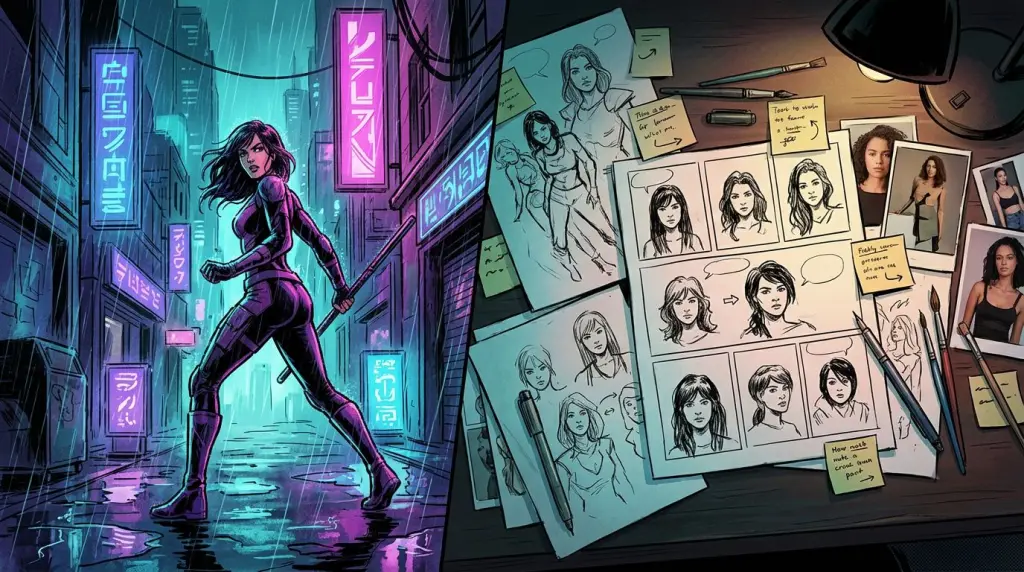
- One approved turnaround / face sheet as the master reference (front / 3/4 / expression row)
In Midjourney: generate that sheet once, then always re-anchor to the same master file (Edit attachments on V8.x, or --oref on V7). Do not chain panel N as the only reference for panel N+1 — small drift compounds into a new face by page three.
In a story-first tool: save the same people as persistent profiles so chapter 4 does not reinvent the jawline from “redhead, cool.” See How to Create Consistent Comic Characters with AI and TabStory’s AI character generator flow for the cast-lock pattern.
Step 3 — Storyboard the episode before spending GPU
Map beats: establishing shot → interaction → turn → reaction → button. Decide which one panel is allowed to be a Midjourney splash. Fix talky boards in text first.
TabStory’s AI storyboard / AI storyboard generator path is built for this: paste a scene, edit panel jobs and dialogue, then generate — instead of discovering pacing problems after twenty Discord upscales.
Step 4 — Generate panels with a fixed recipe
Worked mini-example (illustrative): after you approve a master face sheet URL:
comic splash, same young woman as reference, short copper bob, left-ear silver stud,
rain-soaked Tokyo alley, three-quarter view, shocked expression looking off-panel,
gritty ink-and-wash graphic novel, heavy shadow, muted palette, clear facial features
--ar 2:3
On V8.x, attach the master sheet (and optional second expression ref) via Edit Model / Attach to prompt. On V7, append --oref MASTER_URL --ow 150 (raise toward ~200–300 if high stylize fights the likeness; Midjourney generally warns against casually exceeding ~400). Keep the same copper-bob / stud trait line on every panel prompt in the chapter.
For Midjourney panel batches:
- Same master character reference(s)
- Same style string or
--srefrecipe every time - Short panel-specific action + camera + emotion
- Compare each result to the master sheet at thumbnail size (phone reading size), not only at 100% zoom
- Local-edit or regenerate misses; do not “accept pretty wrong”
For chapter delivery inside TabStory: paste the scene via novel to comic or AI manga generator, lock cast once, regenerate the one bad panel.
Step 5 — Letter and assemble outside the image model
Midjourney will not place balloons with correct tails. Plan lettering in your layout tool. Leave safe negative space in prompts when you know a balloon will sit top-left.
Midjourney vs AI comic generator: fair comparison
| Criterion | Midjourney (2026) | Story-first comic AI (e.g. TabStory) |
|---|---|---|
| Peak single-image quality | Usually highest | Strong, style-pack dependent |
| Character consistency mechanism | Reference images (Edit / Omni); manual | Persistent cast profiles |
| Script / chapter input | None native | Paste scene → board → pages |
| Panel regenerate in sequence | Re-prompt / edit one still | Regenerate one panel in chapter |
| Style range | Extremely wide | Curated comic/manga/webtoon packs |
| Speech bubbles & page object | External tools | Part of comic project |
| Best default use | Covers, key art, splashes, style R&D | Serialized episodes with locked cast |
For a wider tool matrix (pricing and feature columns), see AI Comic Generator Comparison 2026.
Decision checklist (print this)
Stay Midjourney-primary if:
- Deliverable is one cover or a short pitch set
- You already letter/composite in Clip Studio / Photoshop
- You accept regenerating drifted faces as normal cost
Move continuity out of Midjourney (hybrid or story-first) if:
- Readers must recognize the same lead across chapters
- You think in scenes and dialogue, not Discord prompts
- You need a board you can edit before paying for art
- Multi-character scenes regularly melt features together
Soft path into TabStory (when it fits)
You do not have to abandon Midjourney. A clean split many creators use:
- Design exploration + cover in Midjourney
- Approve cast sheets
- Produce chapter boards and sequential pages in TabStory with locked characters
- Optionally drop a Midjourney splash into the chapter opener for peak drama
Start from novel to comic if you are adapting prose, or the AI storyboard generator if you already write in beats. TabStory will not out-Midjourney Midjourney on a single gallery still — and we will not claim it does.
FAQ
Can Midjourney make a full comic in 2026?
You can assemble a comic from Midjourney stills, yes. Midjourney does not ship a full comic production object (script, board, balloons, chapter continuity). Plan for external layout and a strict reference discipline — or a comic-native tool for the sequential half.
Is --cref still the way to keep characters consistent?
Not on the current V8.x default path. Midjourney’s docs point V8.1/V8.2 users to the Edit Model (up to four reference images), which replaces Character Reference and Omni Reference. V7 users still use --oref / --ow. Always check the live Version and Edit Model pages — parameters change between models.
Why does my Midjourney character look different every chapter?
Common causes: chaining last panel → next panel as the only reference (drift compounds); changing style weight without reinforcing traits in text; multi-character attribute blend; treating --sref as a face lock. Re-anchor to one master sheet and keep a written trait list.
Midjourney or an AI comic generator for a webtoon series?
If the product is a series with the same cast every week, prioritize tools that treat cast + board + vertical pages as first-class. Use Midjourney for covers and hero stills. If the product is a single iconic image, Midjourney is often the better default.
Does Niji 7 fix comic consistency?
Niji 7 improves anime-oriented coherency and detail, which helps character readability. It does not turn Midjourney into a chapter database. You still need reference discipline and a storyboard.
Maintenance note
Midjourney’s default version and reference stack changed materially through 2025–2026 (V7 Omni Reference → V8 Edit Model). Re-verify parameters on Midjourney’s official docs before you publish a tutorial of your own. This article’s feature claims were checked against Midjourney documentation on November 5, 2026 (Asia/Shanghai).
Sources (primary)
- Midjourney — Version (V8.2 default, Edit Model notes, Niji 7)
- Midjourney — Edit Model
- Midjourney — Omni Reference
- Midjourney — Style Reference
- Midjourney updates — Omni-Reference announcement
- Tab Story vs Midjourney
By TabStory Team — for creators stuck between beautiful Midjourney stills and a cast that must survive chapter two.