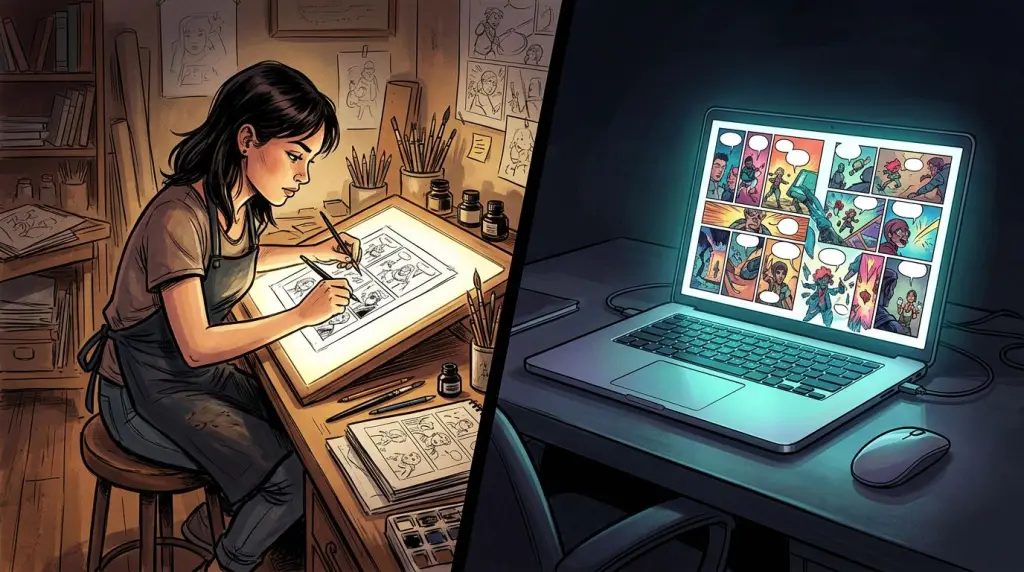
Deciding between an AI comic generator vs hiring an artist is one of the most practical questions a solo creator faces in 2026. The answer isn't obvious. It depends on your budget, your timeline, how many chapters you plan to publish, and whether your story needs a locked visual identity across dozens of episodes. This article breaks down real numbers, real workflows, and real failure cases so you can make an informed call.
What Does It Actually Cost to Hire a Comic Artist?
Hiring a comic artist in 2026 typically costs between $50 and $300 per finished page, depending on style complexity, the artist's experience, and whether you need color. A full 24-page chapter can run $1,200–$7,200. Webtoon artist commission prices skew lower per panel but add up fast across a long series.
Let's put real numbers on the table.
A beginner artist on platforms like ArtStation or Twitter/X might charge $50–$80 per page for black-and-white line art. Mid-tier artists with a portfolio and consistent style charge $100–$180 per page. Experienced artists who specialize in webtoon or manga formats often charge $150–$300 per page, sometimes more for painted color work.
Here's how that stacks up for a 10-episode webtoon series, each episode running 30 panels (roughly 10 pages of vertical scroll):
- Beginner artist: $50/page × 10 pages × 10 episodes = $5,000
- Mid-tier artist: $140/page × 10 pages × 10 episodes = $14,000
- Experienced webtoon artist: $220/page × 10 pages × 10 episodes = $22,000
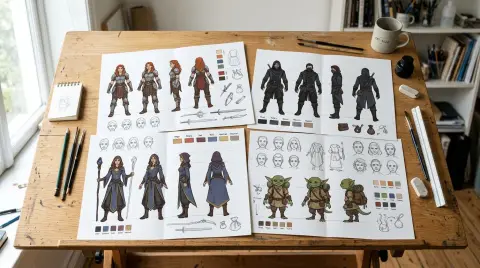
Those numbers don't include revision rounds. Most artists allow 1–2 rounds of revisions per page. If your script changes after pencils are done, you may pay for rework. Character design sheets—the reference documents that keep your cast visually consistent—are often billed separately at $80–$400 per character.
Turnaround time is the other variable. A single artist working full-time can finish roughly 3–5 pages per week. A 10-page chapter takes 2–3 weeks minimum. A 10-episode series could take 5–7 months, assuming no delays, no life events, and no creative disagreements.
Hidden Costs Most Creators Miss
Commissioning art isn't just the page rate. Factor in:
- Contract and rights negotiation. Who owns the art? Work-for-hire vs. royalty splits matter if you plan to monetize.
- Communication overhead. Briefing an artist, reviewing sketches, writing feedback—this takes real hours every week.
- Style drift. Over a long series, an artist's style evolves. Panel 1 of Chapter 1 may look noticeably different from Panel 30 of Chapter 10.
- Artist availability. Popular artists book out months in advance. If your artist goes on hiatus, your publishing schedule stops.
How Much Does an AI Comic Generator Actually Cost?
AI comic generator pricing in 2026 ranges from free tiers with limited exports to $20–$80/month for unlimited or high-volume plans. A 10-episode webtoon series that would cost $5,000–$22,000 with a human artist can be produced for $200–$800 in AI tool costs, plus your time.
The cost structure is fundamentally different. You pay a subscription or per-generation fee, not a per-page rate. That changes the economics dramatically for high-volume creators.
For context, here's a rough monthly cost breakdown for common AI comic workflows:
- Free tier (most tools): 20–50 panels/month, watermarked or low-res exports
- Starter plan ($15–$25/month): 200–500 panels, standard resolution
- Pro plan ($40–$80/month): Unlimited or high-volume panels, HD export, priority generation
If you publish one 30-panel episode per week, you need roughly 120 panels per month. A $40/month pro plan covers that comfortably. Over 10 episodes, your tool cost is around $100–$160. Add time cost—roughly 4–8 hours per episode for scripting, prompting, and layout—and your real investment is still a fraction of commissioning.

AI Comic Generator vs Hiring an Artist: Tool Comparison Table
The right tool depends on your workflow, not just your budget. TabStory is built around a locked cast and chapter-as-source-of-truth approach. Midjourney produces stunning single images but has no native comic workflow. Canva is fast for templates but not for sequential storytelling.
| Tool | Best For | Character Consistency | Story/Text Input | One-Panel Regenerate | Price Range |
|---|---|---|---|---|---|
| TabStory | Writers turning chapters into comics; locked cast across episodes | High (locked character profiles) | Yes — paste chapter text directly | Yes | Free tier; paid plans from ~$20/mo |
| Midjourney | Single illustration quality; concept art | Low (manual prompt engineering required) | No native story input | No — reprompt from scratch | $10–$120/mo |
| Canva | Template-based social comics; non-sequential content | Low | No | No | Free; Pro ~$15/mo |
| Dashtoon | Mobile-first webtoon creation | Medium | Partial | Partial | Free tier; paid plans |
| LlamaGen | Rapid panel generation; experimental workflows | Medium | Partial | Varies | Free/paid tiers |
| GenToon | Manga-style generation; short-form stories | Medium | Limited | Limited | Free/paid tiers |
| Story-to-Manga Studio (e.g., TaleAtelier) | Converting written scenes to manga panels | Medium-High | Yes | Partial | Subscription-based |
For more detailed head-to-head breakdowns, see the Midjourney, Dashtoon, and Canva comparison pages.
The column that matters most for serialized fiction is character consistency. If your protagonist looks different in every other panel, readers disengage. TabStory's locked character profile system means you define your character once—face shape, hair, costume, expression range—and every generated panel pulls from that locked reference. That's the workflow difference, not a marketing claim.
Speed: How Fast Can You Actually Publish?
An AI comic generator can take a 2,000-word chapter draft to a 30-panel webtoon episode in 4–8 hours of active work. The same chapter with a commissioned artist takes 2–4 weeks minimum. If your publishing cadence is weekly, AI is the only viable solo option.
Here's a worked example. Say you're adapting Chapter 3 of a fantasy webtoon. The chapter is 1,800 words. It has four scenes: a market argument, a chase through narrow streets, a rooftop confrontation, and a quiet aftermath.
With a commissioned artist:
- Write a detailed panel-by-panel script (2–4 hours)
- Send to artist, wait for sketch thumbnails (3–7 days)
- Review thumbnails, send notes (1–2 hours)
- Wait for pencils (5–10 days)
- Review pencils, approve or request changes (1–2 hours)
- Wait for inks and color (5–10 days)
- Final review and delivery
Total: 2–4 weeks, $700–$2,200 for a 10-page chapter
With TabStory:
- Paste Chapter 3 text into the chapter input field
- Confirm your locked character profiles for the cast appearing in this chapter
- Review the auto-generated panel breakdown, adjust scene cuts if needed (30–60 minutes)
- Generate panels in batches, regenerate any that miss the mark (2–4 hours)
- Arrange panels in the vertical webtoon layout, export (30–60 minutes)
Total: 4–8 hours, $0–$40 in tool cost
The speed gap is real. For a writer publishing weekly on Webtoon Canvas or Tapas, a 2–4 week turnaround per chapter makes a weekly schedule mathematically impossible without a team. AI closes that gap.
For a deeper walkthrough of this process, see How to Make a Comic with AI in 2026 (Step-by-Step Guide).
Quality: Where AI Still Falls Short
AI-generated comics in 2026 produce consistent, publication-ready art for most panel types. But complex action sequences, nuanced emotional expressions, and multi-character crowd scenes still produce errors that require regeneration or manual correction. This is the honest failure case.
Let's be specific about what breaks.
Failure Case: The Three-Character Confrontation
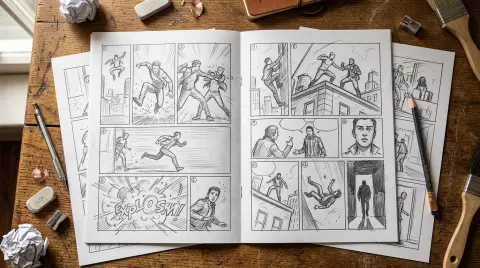
Imagine a scene where three characters stand in a triangle formation, each reacting differently to the same piece of news. Character A is shocked, Character B is hiding a smirk, Character C is looking away.
With a human artist, you describe this in your script and the artist draws it. The spatial relationships are clear. The expressions are distinct. The body language tells the story.
With most AI comic generators, this panel is hard. Common failure modes:
- One character's face reverts to a generic expression
- The spatial composition collapses into a flat line of faces
- A character's locked design drifts (wrong hair color, wrong costume detail)
- Hands are malformed or missing
The fix in TabStory is to regenerate the panel with a more specific prompt, or break the three-character panel into two panels—a two-shot and a reaction close-up. That's a script decision, not just a technical one. It changes the pacing of your story. Sometimes that's fine. Sometimes it's not.
Other Known Weak Spots
- Dynamic action: Punches, parkour, sword fights—AI tends to freeze motion awkwardly. Static poses read better than mid-motion frames.
- Architectural consistency: If your story is set in a specific building, the interior may look different panel to panel unless you lock a background reference.
- Text in panels: Never rely on AI to render in-panel text, signs, or speech bubble placement. Always handle lettering in post-production.
- Subtle aging or injury: If a character should look exhausted by Chapter 10, AI won't track that drift unless you prompt for it explicitly.
None of these are dealbreakers for most indie creators. They're constraints to design around. A human artist has constraints too—availability, cost, communication gaps. The question is which constraints fit your project.
When Hiring an Artist Is Still the Right Call
Hire a human artist when your project requires a signature visual style that defines the IP, when you're pitching to publishers who expect original art, or when your story's emotional depth depends on expressive nuance that current AI tools can't reliably produce.
Specific scenarios where commissioning wins:
- Publisher submissions. Major publishers and most anthology competitions still expect human-created art. AI-generated submissions are often disqualified.
- Merchandise and licensing. A distinctive hand-drawn style is easier to protect and license. AI art ownership rights remain legally murky in many jurisdictions.
- Highly expressive character work. If your story lives or dies on a character's micro-expressions—grief, irony, quiet rage—a skilled artist will outperform AI every time.
- Collaborative creative development. A good artist doesn't just execute your script. They push back, suggest better compositions, and make the story stronger. That creative dialogue has real value.
If you're building an IP you plan to pitch, sell, or license, the investment in a human artist is often the right long-term decision. If you're building a self-published webtoon to grow an audience, test a concept, or adapt an existing novel, AI tools are a legitimate production path.
For writers specifically, the AI Comic Generators for Writers: Turn Your Fiction Into Visual Stories guide covers how to adapt prose for panel-based storytelling.
The Hybrid Workflow: AI for Volume, Artist for Key Moments
Some creators are running a hybrid model. They use an AI comic generator for the bulk of their episode production—establishing shots, dialogue-heavy scenes, transitions—and commission a human artist for cover art, key emotional beats, and promotional images.
This approach makes financial sense. A 30-panel episode might have 25 panels that AI handles cleanly and 5 panels that need a human touch. Commissioning just those 5 panels costs $250–$1,500 instead of $1,500–$9,000 for the full episode. Your publishing cadence stays weekly. Your most important visual moments get the quality they deserve.
If you're converting an existing novel or Wattpad story into a webtoon series, the novel to comic workflow handles the volume side of this equation. You bring in a human artist for the moments that matter most.
AI Comic Generator vs Hiring an Artist: Quick Decision Framework
Choose an AI comic generator if you're a solo creator, working on a serialized webtoon or manga adaptation, need to publish consistently, and have a limited budget. Choose a human artist if you're building a flagship IP, need a legally defensible art style, or are submitting to traditional publishers.
Use this as a quick filter:
| Your Situation | Recommended Path |
|---|---|
| Solo creator, weekly publishing schedule | AI comic generator |
| Adapting a novel or Wattpad story to webtoon | AI comic generator (text-to-comic workflow) |
| Building an IP for publisher pitch | Human artist |
| Testing a concept before investing | AI comic generator |
| Need cover art and key scene illustrations | Human artist (for those specific assets) |
| Full series, 50+ episodes planned | Hybrid (AI for volume, artist for covers) |
| Anthology submission | Human artist |
For a broader look at the tools available, Best AI Comic Generators in 2026: Tested and Ranked covers the current landscape in detail.
FAQ
How much does a comic artist cost per page in 2026?
Comic artist rates in 2026 range from $50–$80/page for beginners to $150–$300/page for experienced webtoon and manga specialists. A full 10-page chapter typically costs $500–$3,000 depending on style and color requirements.
What is the average webtoon artist commission price?
Webtoon artist commission prices typically run $40–$150 per episode panel or $400–$2,000 per full vertical episode (30 panels). Rates vary by artist experience, style complexity, and whether backgrounds are included.
Can an AI comic generator match the quality of a human artist?
For most panel types—dialogue scenes, establishing shots, character close-ups—AI comic generators in 2026 produce publication-ready results. Complex multi-character action scenes and subtle emotional expressions still require regeneration or human correction.
Is AI art vs commissioned art a legal issue for publishing?
AI-generated comic art exists in a legally gray area for copyright in many countries. For self-publishing on platforms like Webtoon Canvas or Tapas, this is rarely a practical barrier. For traditional publisher submissions, licensing, or merchandise, consult a legal professional and check platform-specific policies.
What's the fastest way to turn a written story into a comic?
The fastest workflow is to use an AI comic generator with native text or chapter input, locked character profiles, and vertical webtoon export. Paste your chapter text, review the auto-generated panel breakdown, generate, and export. A 30-panel episode can be ready in 4–8 hours of active work.
If you're ready to test the AI side of this comparison with your own story, start with the AI comic generator at TabStory. Paste a chapter, lock your characters, and see a full episode take shape before you commit to anything.